

Grill
Low Flame: Burners Stuck at a Weak Blue Line
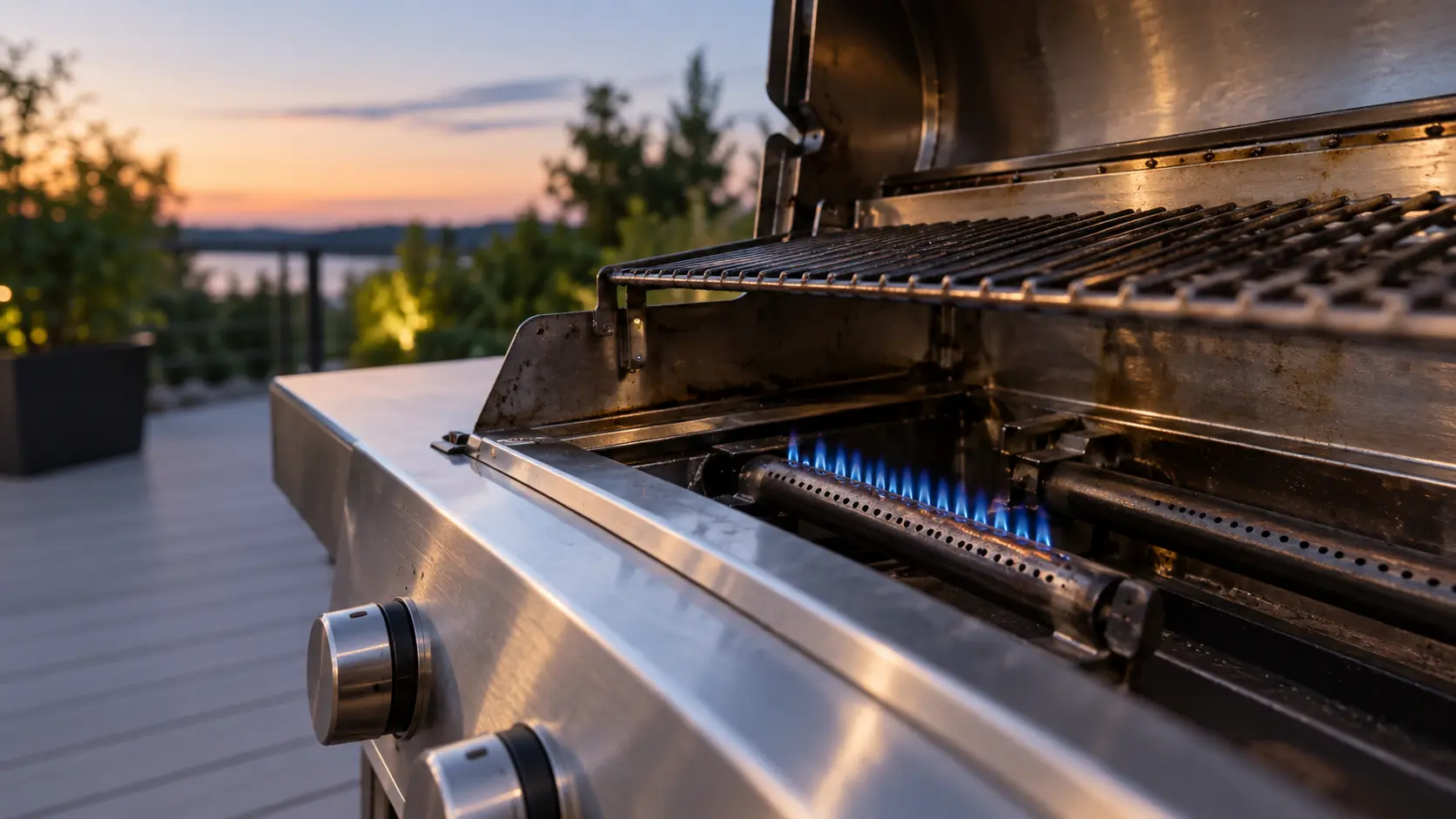
A grill low flame is a burner that lights but sits as a short, weak line of blue even with the knob on high, so the grates never climb to searing heat.
Mon–Sat, 8am–8pm
- 5 checks before you book
- 5 questions that narrow it
- 6 causes, cheapest first
Book a visit
Three short steps, about a minute.
or call (844) 660-6426
Loading appointment form…
The appointment form couldn’t load. Please try again.
What it
usually means.
Flame height is gas volume. A grill makes a tall, lively flame only when the regulator delivers its set pressure and the orifice at each valve passes the amount of gas it was sized for. The most common cause on propane is the regulator's bypass: open the tank while a knob is on, or crack it open quickly, and the device limits flow to a trickle, enough for a flicker and no more. Resetting it takes a minute. Next on propane come a tank close to empty, whose pressure sags as it runs down, and cold weather, which slows the liquid's boiling into vapor. On natural gas the big mistake is fuel type: a grill ordered for propane and hooked to the house line, or converted with a kit but left with its small propane orifices, never gets enough gas. After that come the burners themselves, with clogged ports or webs in the venturi, and a regulator worn out inside. A low flame is not dangerous in itself, but a starved burner blows out easily in wind and can then let gas escape unlit, so keep the grill in view while it runs.
 The 6 causes, cheapest first
Answer these first
Is the flame low on every burner or only one?
Was the tank opened with a knob already on, or in a hurry?
How full is the tank, and is the weather cold?
Is the grill on propane or natural gas, and was it ever converted?
Does the flame jump up for a moment and then sink as the grill runs?
Check these
before you book.
Grill low flame: 5 checks, and none of them costs anything.
Turn every knob off, close the tank, wait a minute, then open the tank valve slowly and light one burner as the manual shows.
Lift or weigh the tank; a nearly empty one is the cheapest answer there is.
Find the data plate and note which gas the grill was built for, then compare it with what feeds it.
Also worth checking
- Once cold, lift the grates and look along each burner for ports closed by rust or grease.
- Keep the grill in sight while it runs low, and turn the knob off if a gust puts a burner out.
How soon does it need a visit?
A low flame can wait for an ordinary booking. If a burner goes out with its knob on and you smell gas, go to the gas smell page first.
The causes,
cheapest first.
6 things grill low flame: burners stuck at a weak blue line turns out to be, from regulator in bypass after the tank was opened with a knob on to burner ports closed by rust.
The cost guide-
01 no repair
Regulator in bypass after the tank was opened with a knob on
The safety device inside the regulator has throttled the flow. Every knob off, tank closed, a minute's wait, then the tank opened slowly and the grill relit resets it.
-
02 no repair
Propane tank running low or chilled
A tank near the bottom, or a cold morning, lowers the pressure the regulator can work with. A full tank shows the difference at once.
-
03 low
Webs or debris in the venturi or orifice
A partly blocked tube or orifice lets through only part of the gas the burner needs. Cleaning the tubes and the orifices restores it.
-
04 low to moderate
Regulator or hose worn inside
A regulator left in the sun for years, or a hose with a collapsed lining, passes less gas than it should. A pressure check confirms it before they are replaced.
-
05 moderate
A natural gas grill fitted with propane orifices
Propane orifices are far smaller than natural gas ones. A grill fed from the house line through the wrong orifices, or converted without every part of the maker's kit, never gets enough gas; the conversion is finished by a technician.
-
06 moderate
Burner ports closed by rust
When rust scale fills most of the ports, gas has too few ways out and the flame stays short. The burners are replaced with parts for the model.
What else
it could be.
Most often confused with grill not getting hot enough to sear, then gas grill won't light: knob on, clicking, no flame.
All problemsCodes that come with it
Burner N failed to igniteLynx · IgnitionBurner N failed to stabilizeLynx · Flame and gas flowBurner N cannot reach target temperatureLynx · Temperature and probesBurner N has no flameLynx · Flame and gas flowBurner N temperature not steadyLynx · Temperature and probesBurner N gas valve has malfunctionedLynx · Flame and gas flow
Also related


The makes
it happens on.
23 makes on this site; grill low flame: burners stuck at a weak blue line can show up on any of them. Each mark opens that make's own page.
All 23 brandsGrill Low Flame: Burners Stuck at a Weak Blue Line,
where we come out.
9 metros, each with its own page.
All service areasTampa BayFL · 31 areas
Miami / South FloridaFL · 47 areas
New York MetroNY · 75 areas
HoustonTX · 36 areas
ChicagoIL · 50 areas
Los AngelesCA · 95 areas
San DiegoCA · 31 areas

Questions about
grill low flame: burners stuck at a weak blue line.
Why is the grill flame weak only on cold days?
Can we change the orifices ourselves to run the grill on natural gas?
The flame was strong last year and is weak on every burner now. Is it the regulator?
Is a small blue grill flame safer than a tall one?
Back to your everyday
Still seeing grill low flame: burners stuck at a weak blue line?
Book with what you checked above — 5 answers save the technician the first part of the visit.