


Grill
Yellow Flame and Soot on the Grates
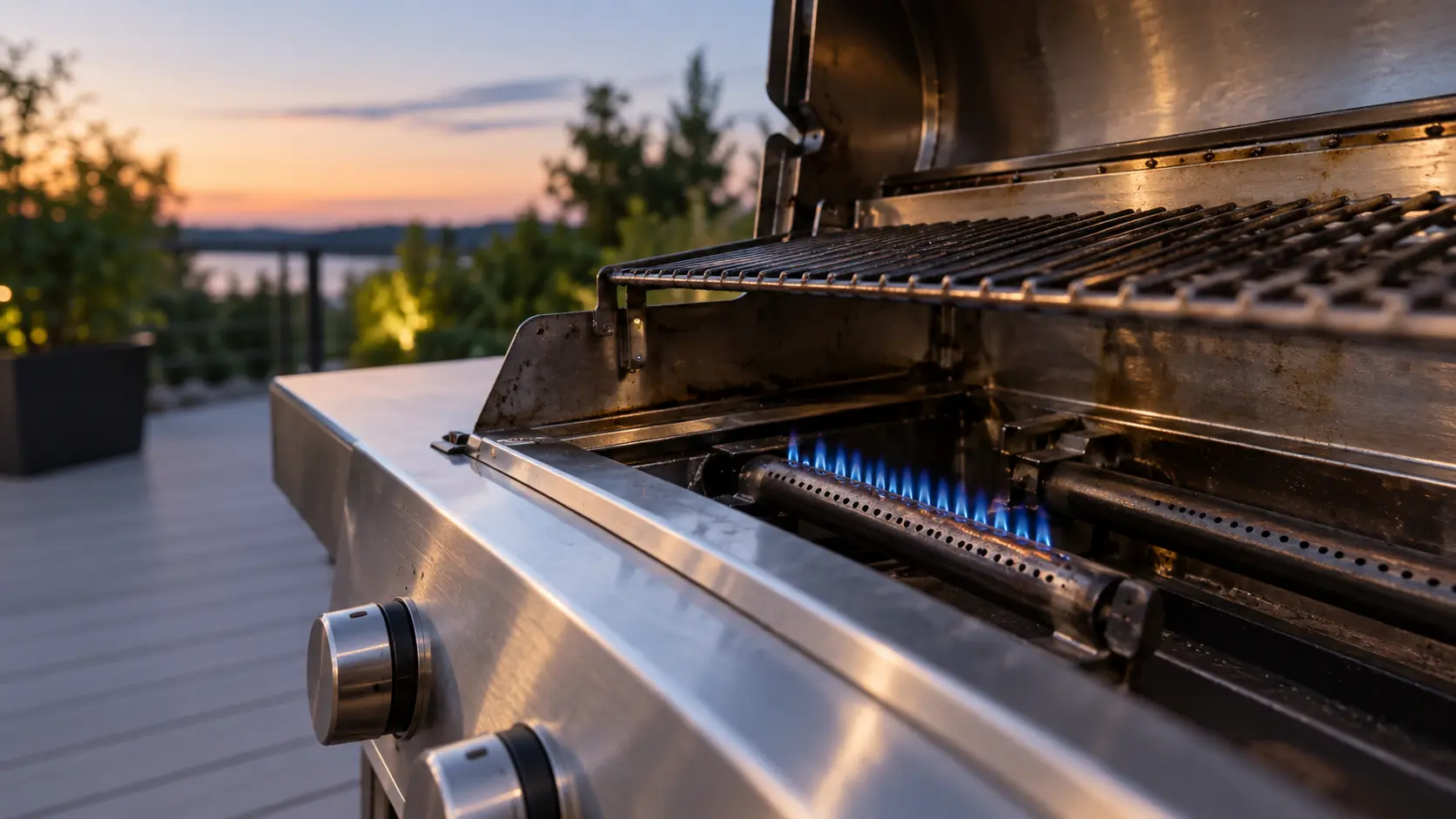
A grill yellow flame burns tall, lazy and orange instead of crisp blue, and often leaves black soot on the grates, the underside of the lid and the food.
Mon–Sat, 8am–8pm
- 5 checks before you book
- 5 questions that narrow it
- 5 causes, cheapest first
Book a visit
Three short steps, about a minute.
or call (844) 660-6426
Loading appointment form…
The appointment form couldn’t load. Please try again.
What it
usually means.
A healthy gas burner flame is mostly blue, with small yellow tips here and there. Blue means the gas is mixing with enough air before it burns. Every burner tube has an air inlet at its front, sometimes with an adjustable shutter, and anything that narrows it starves the mix: a web or a mud dauber's nest, a shutter knocked shut during cleaning, a burner not lined up with its orifice. The flame then burns yellow, tall and soft, lays down soot and gives off more carbon monoxide, which is one reason a grill is never run in a garage or under a closed porch roof. A little yellow is also normal while a burner is new, while seasoning oil or grease burns off, or when pollen and dust drift into the flame. The serious case is a fuel mismatch: propane fed to a grill set up for natural gas pushes far too much gas through the larger orifices and makes big, smoky, yellow flames. That grill is shut down and not used until it is set up correctly. Webs in the tube are also the first step toward flashback, so a yellow flame on one burner deserves attention before the busy season.
 The 5 causes, cheapest first
Answer these first
Is the yellow flame on one burner or on all of them?
Does it turn blue after ten minutes of running, or stay yellow?
Is there soot on the grates, the lid or the food?
Was the grill converted between propane and natural gas, or connected to a new supply?
Has the grill sat unused for weeks?
Check these
before you book.
Grill yellow flame: 5 checks, and none of them costs anything.
Run the grill for ten minutes with the lid open and see whether the flame turns blue once warm.
Look at each burner through the grates; one yellow burner points to its tube, all of them to the supply.
Read the data plate for the gas type the grill was built for, and compare it with what feeds it.
Also worth checking
- Use the grill only in open air, never in a garage, a tent or under a closed porch roof.
- If the flames are large and smoky across every burner, turn the knobs off, close the gas and keep it closed until a visit.
How soon does it need a visit?
A small yellow tip is not urgent. Large, smoky yellow flames on every burner, or a yellow flame with fire near the knobs, mean shut the gas and book before the next use; the flashback page covers the second.
The causes,
cheapest first.
5 things grill yellow flame and soot on the grates turns out to be, from oil, grease or pollen burning off to propane connected to a grill set up for natural gas.
The cost guide-
01 no repair
Oil, grease or pollen burning off
Seasoning, cleaning spray and pollen tint the flame for the first minutes. If it turns blue once the grill is warm, nothing is wrong.
-
02 low
A web or insect nest in the venturi
A tube partly closed by a web lets in too little air, and the flame goes yellow on that burner alone. Brushing the tube clears it.
-
03 low
Air shutter closed or burner off its orifice
A shutter nudged shut, or a burner seated askew after cleaning, upsets the mix. The technician sets both and checks the flame.
-
04 low to moderate
Burner ports eaten wide by rust
Ports that have rusted into large ragged openings let gas out faster than it can mix, and the flame lifts yellow. The burner is replaced.
-
05 moderate
Propane connected to a grill set up for natural gas
The flames are large, smoky and yellow because far too much gas reaches the burners. Close the tank and keep the grill out of use until its orifices and regulator match its fuel.
-
What it costs
Every repair on the site's cost scale, side by side
Open the cost guide
What else
it could be.
Most often confused with grill flashback: flames behind the knobs or under the panel, then grill low flame: burners stuck at a weak blue line.
All problems


The makes
it happens on.
23 makes on this site; grill yellow flame and soot on the grates can show up on any of them. Each mark opens that make's own page.
All 23 brandsGrill Yellow Flame and Soot on the Grates,
where we come out.
9 metros, each with its own page.
All service areasTampa BayFL · 31 areas
Miami / South FloridaFL · 47 areas
New York MetroNY · 75 areas
HoustonTX · 36 areas
ChicagoIL · 50 areas
Los AngelesCA · 95 areas
San DiegoCA · 31 areas

Questions about
grill yellow flame and soot on the grates.
How much yellow in a grill flame is normal?
Why is there black soot under the grill lid?
Can a yellow flame make grilled food taste off?
Is a yellow flame dangerous on an open patio?
Back to your everyday
Still seeing grill yellow flame and soot on the grates?
Book with what you checked above — 5 answers save the technician the first part of the visit.