

Built-in Gas
Grill Repair
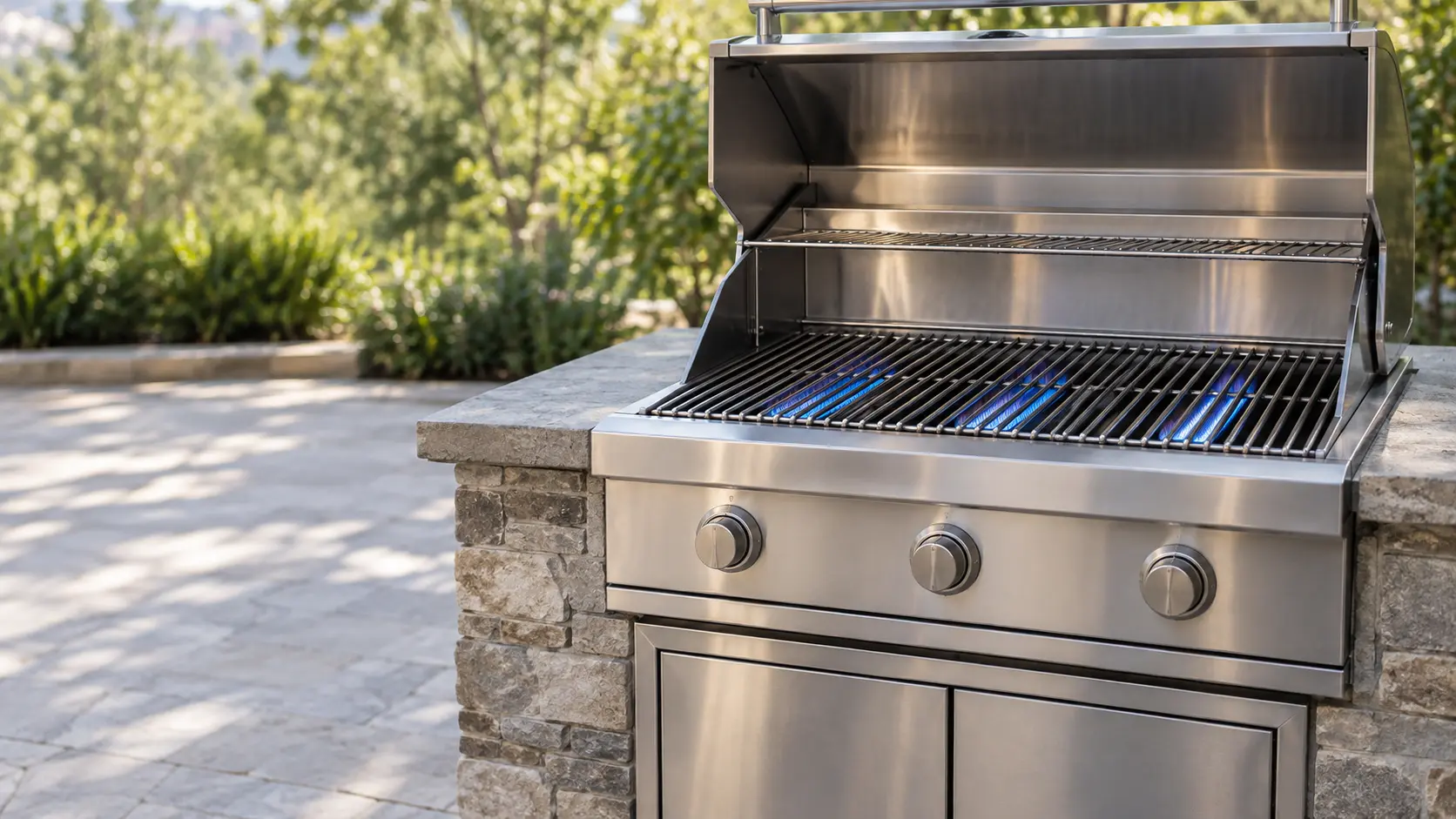
A stainless grill head dropped into a masonry or steel island, fed by a tank or the house gas line, with its burners, knobs and lid working in open weather.
Mon–Sat, 8am–8pm
- 4 things that fail on it
- 22 makes build it
- 7 problems it shows
Book a visit
Three short steps, about a minute.
or call (844) 660-6426
Loading appointment form…
The appointment form couldn’t load. Please try again.
Is yours
a built-in?
A built-in gas grill is a head without legs: a stainless firebox, a hood on heavy hinges and a control panel, set into a cutout in the island and resting on its own flanges. Under the grates it holds three to six main burners, each with a tube that narrows into a venturi behind the knob, where gas from a brass orifice mixes with air through an adjustable shutter. Above every burner a heat shield or a tray of ceramic briquettes catches drips and spreads the heat, and below them a pull-out grease tray runs the full width. Many heads add a rear infrared burner for the rotisserie, a halogen or LED light in the hood, and a spark module that fires every electrode at once. The gas comes up through the floor of the island on a flexible connector, either from a propane tank with its regulator or from the house line at lower pressure through a different set of orifices. Because the head never moves, whatever weather, grease and insects do to it happens in one spot, year after year, and the repairs follow that pattern: burners that rust from beneath, ports blocked by webs, igniters that stop reaching their gap.
 What fails on a built-in gas grill
How to tell
The grill has no cart and no wheels: its firebox sits down in a cutout in a stone, stucco or steel counter, and only the hood and the knob panel stand above it.
The gas arrives from below through the island floor, and the tank or the house shutoff is behind an access door under the head rather than hanging on the side.
Pulling the grease tray shows it running the full width of the head, and the rating plate is on that tray's frame or behind the panel.
A rotisserie motor bracket on one side of the hood and an infrared back burner along the rear wall are common on these heads.
Not yours?Freestanding gas grillInfrared grillPellet and hybrid grill
What fails
on this design.
On a built-in gas grill: main burners eaten from the underside, spark module, electrodes and their wires, venturi tubes blocked by spiders and wasps, hood springs, handles and the light.
The problems it showsMain burners eaten from the underside
Grease and salt collect beneath each tube, and a burner that looks sound from above can have ports torn into one long slot along its belly. The flame climbs out of the gap, one zone runs far hotter than its neighbors, and the knob no longer turns it down.
Spark module, electrodes and their wires
A single module often feeds every burner, so a wet connector or a spent battery silences all of them at once. When only one burner stays dark, its electrode has usually drifted from the port, cracked its ceramic, or had its wire cooked where it passes close to the firebox.
Venturi tubes blocked by spiders and wasps
The narrow neck behind each knob is warm, dark and smells faintly of gas, which draws spiders and mud wasps. A web in that neck starves the flame of air, and the gas that cannot move forward can burn backward toward the panel.
Hood springs, handles and the light
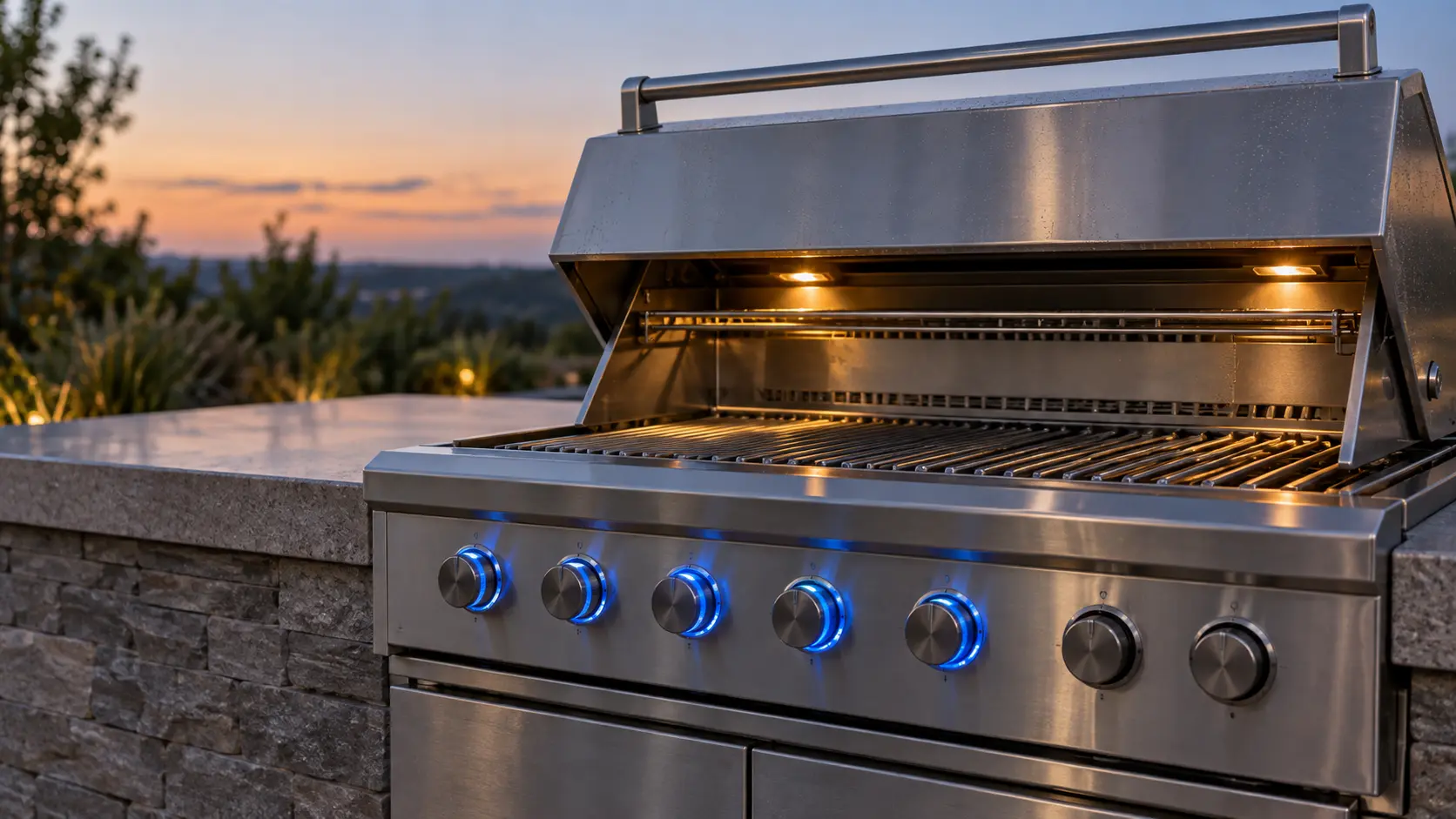
The counterweight or spring that holds the heavy hood open tires, and the lid then drops on whoever is cooking. The hood light's lens gathers grease, its socket corrodes in the damp, and a transformer under the island can quietly fail.
Getting at it,
and whether to.
Please leave the grates, heat shields and grease tray in the head; the technician lifts them out to reach the burners and sees how they wore in place.
What repairs costOn the visit
- Open the access door below the grill and clear what is stored in front of the tank or the gas shutoff, so the supply and its regulator can be reached.
- If you smell gas at any point, close the tank valve or the shutoff, keep the hood open, make no flame and step away before you call.
- Tell us whether the head runs on propane or the house line, and whether a rotisserie kit or a hood light is part of the problem.
Repair or replace
A built-in grill head is usually worth repairing, because the cutout in the island was made for that exact firebox and a new head of another make or size may need the counter recut. Burners, electrodes, a spark module, heat shields and a light are modest next to a replacement head. The honest exception is a firebox whose bottom or hood seam has rusted through, or a discontinued head for which no valve or burner can still be found; there the technician sets both paths in front of you and you decide.
Book a visit for a built-in gas grillThe problems
it shows.
On a built-in gas grill, most often grill gas smell at the burners or the tank: what to do now.
All problems
Grill Gas Smell at the Burners or the Tank: What to Do Now
6 causes, cheapest first

Gas Grill Won't Light: Knob On, Clicking, No Flame
7 causes, cheapest first

Grill Uneven Heat: Hot Spots and Cold Corners on the Grates
6 causes, cheapest first

Grill Rotisserie Not Turning or Stalling Under Load
6 causes, cheapest first
Grill Lights Not Working: Dark Knob Lights and Hood Lamps
6 causes, cheapest first

Grill Burners Rusted Through: Holes, Gaps and Ragged Flames
6 causes, cheapest first

Grill Error Code on a Pellet Controller or Digital Panel
7 causes, cheapest first
Who builds
a built-in.
22 of the makes on this site build a built-in gas grill. Each mark opens that make's own page.
All 23 brandsBuilt-in gas grill repair,
where we come out.
9 metros, each with its own page.
All service areasTampa BayFL · 31 areas
Miami / South FloridaFL · 47 areas
New York MetroNY · 75 areas
HoustonTX · 36 areas
ChicagoIL · 50 areas
Los AngelesCA · 95 areas
San DiegoCA · 31 areas

Questions about
built-in gas grills.
Can a technician take a built-in grill head out of the island?
Why does only one burner on my built-in grill refuse to light?
Is it safe to swap my built-in grill from propane to the house gas line?
Back to your everyday
Is it a built-in gas grill?
Say so when you book — it changes what the technician brings and how the visit is planned.