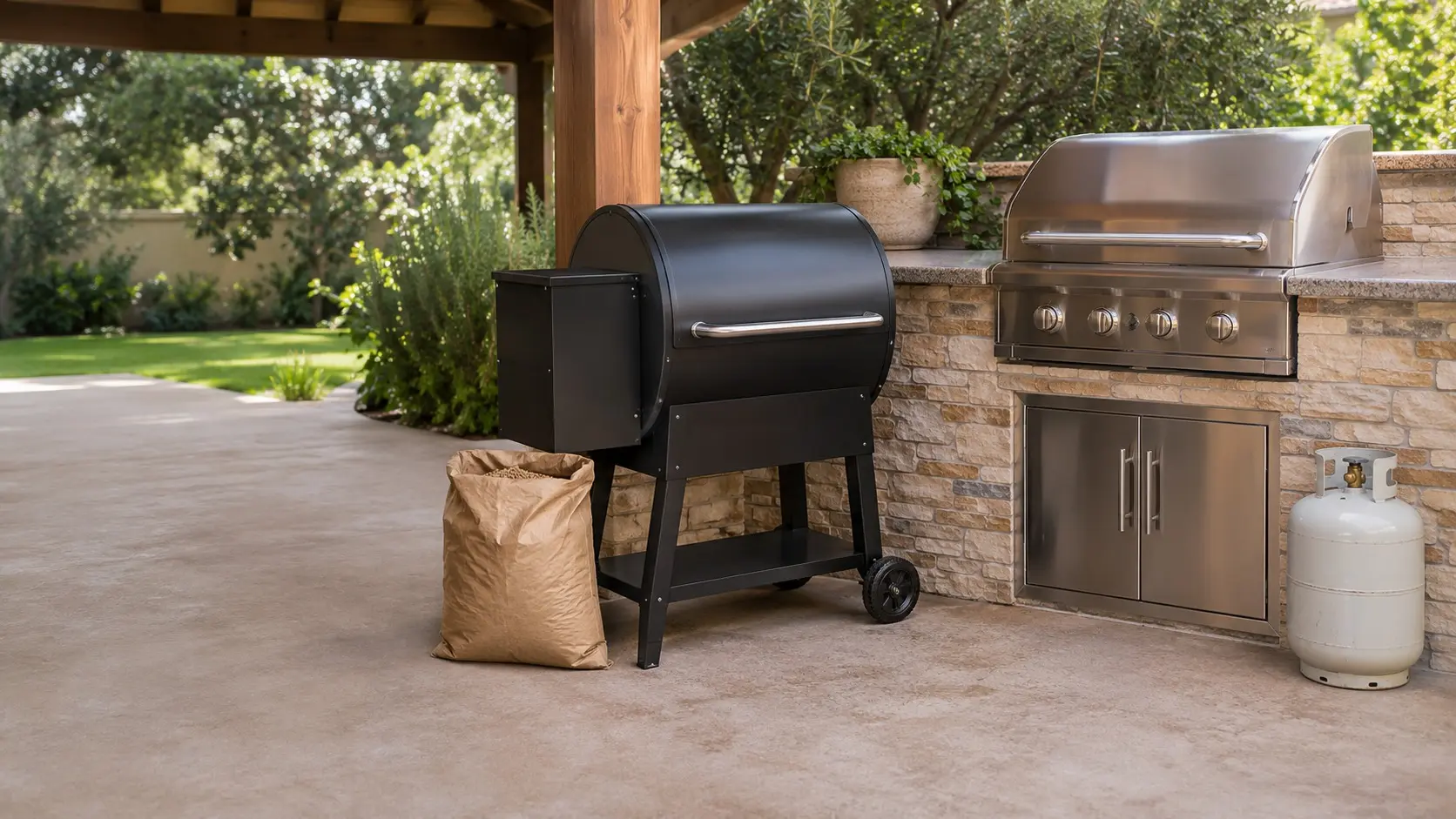
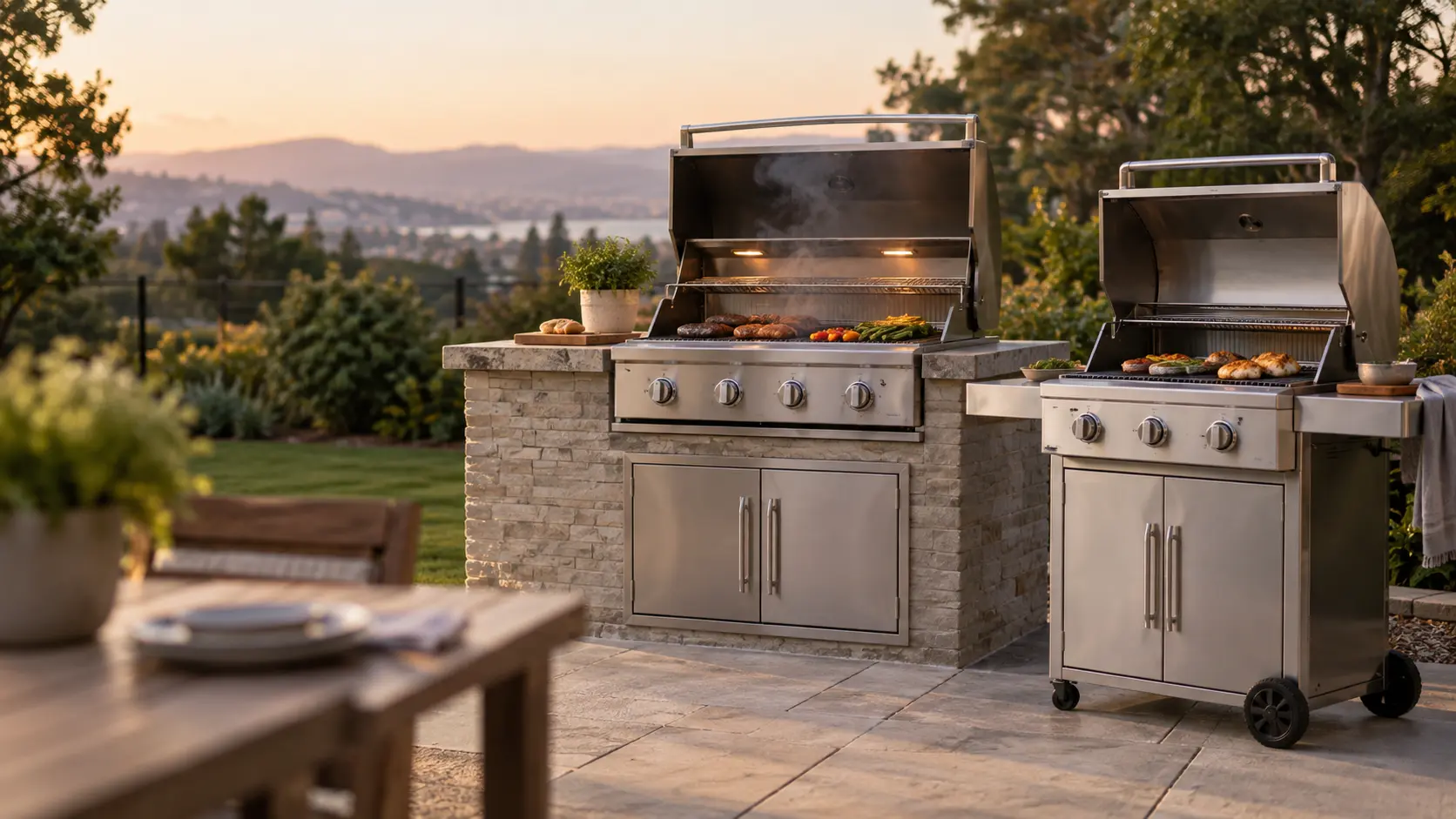

How does each grill make its heat?
A gas grill burns propane or natural gas in tube burners under the grates, and a pellet grill burns compressed wood pellets in a small firepot and moves the heat with a fan. The first is a flame you control with a knob; the second is a fire a controller manages for you.
Gas grill
Gas flows from the tank or line through a regulator and valve to the burners, where a spark igniter lights it. The parts are few and mostly metal: burners, valves, regulator, hose, igniter, heat shields. The comparison of burner types is in infrared or standard burners.
Pellet grill
A hopper feeds pellets through an auger into a firepot, where a hot rod lights them, and a fan and controller hold the chamber at the set temperature. The controller needs household power, so a pellet grill is as much an appliance as a grill. Care routines are in caring for a pellet grill.
How hot and how fast do they get?
Gas grills usually reach cooking heat faster and run hotter at the top end; many pellet grills take longer to come up and top out lower, and the maximum varies by model, so check the spec sheet. If searing steaks is the point, gas, and especially infrared burners, does it better.
| Feature | Gas grill | Pellet grill |
|---|---|---|
| Preheat | Usually the quicker of the two | Often slower to come up |
| Top temperature | Hotter, strong searing | Lower on many models |
| Flavor | Mostly the food and drippings | Wood smoke built in |
| Temperature control | Knobs, you adjust | Controller holds a set point |
| Power needed | None, except some lights | Household outlet |
A pellet grill wins at low and slow work, because the controller holds 225°F for hours and feeds the smoke. A gas grill wins at a quick weeknight sear and at the hot, direct flame that makes grill marks.

What happens in cold weather and wind?
Both lose heat in the cold. A gas grill depends on a tank that delivers less in cold air, covered in grill in cold weather. A pellet grill must burn more pellets to hold temperature and may take longer to preheat, and its electronics dislike a wet cord and a wet outlet.
- Gas: longer preheat, check the tank, block the wind
- Pellet: fill the hopper, keep pellets dry, protect the cord and the controller from rain
How much cleaning does each one need?
A gas grill needs a quick scrape of the grates after each cook and a grease tray empty now and then; a pellet grill needs ash cleaned from the firepot every few cooks and the drip tray and pail emptied regularly. Built-up ash and grease are a fire risk on a pellet grill, and old, damp pellets are the main reason a hopper jams.
Gas upkeep in practice
Brush the grates, empty the tray, and clean burner ports each season; the tray routine is in clean the grill grease tray. Spiders and debris in the venturi tubes are a common cause of yellow, lazy flames, as the flame guide explains.
Pellet upkeep in practice
Vacuum the firepot ash when it builds up, scrape the drip tray, empty the grease pail and store pellets in a dry bin. Dust and ash left in the firepot are what keep the igniter from lighting.
What breaks on each, and what does a repair involve?
Each grill has a short list of parts that fail, and many repairs are a single part. For a gas grill that means burners, igniters, regulators and valves; for a pellet grill, igniters, augers, fans and controllers.
- Gas burners rust and clog, and a grill burner replacement is the usual repair for weak or uneven flame.
- Gas igniters stop sparking; a spark module or wire is the cheap fix.
- Pellet igniter rods wear out and stop lighting the firepot.
- A pellet auger jams on damp pellets or a foreign object, and the motor or controller can fail, which a pellet grill auger and controller repair covers.
- Pellet temperature probes drift, so the grill swings or runs the wrong temperature.
Which costs more over time?
A gas grill usually has fewer parts that can fail and cheaper repairs, but burners are wearing parts that rust out with use and weather. A pellet grill has more electronic parts and uses pellets, which are a running cost. Whether to repair or replace an older grill is in repair or replace a grill.
What about safety and the first-year experience?
Both kinds are safe when kept clean and placed with clearance, but the risks differ. A gas grill's risk is a gas leak or a flare-up from old grease, so an owner who smells gas turns the knobs off, closes the supply and steps back. A pellet grill's risks are ash and grease in the firepot area and a power cord that gets wet or pinched, so it belongs on a dry spot with its cord clear of the heat.
In the first year, most gas owners meet a clogged burner or a tired igniter, while most pellet owners meet a jammed auger from damp pellets or a firepot choked with ash. Both are the sort of problem that a quick look at the manual's troubleshooting page, and the checklist in grill checks before booking, will often sort out.
Which one should you buy?
Choose gas if you want fast heat, hard searing and the simplest parts. Choose pellet if you cook low and slow and want smoke without watching a fire. Some households own both. Pellet grills need an outlet; gas needs a tank or a line, and the sizes and fit matter more on a built-in, as built-in or cart grill explains.


