
How a tube burner and an infrared burner make heat
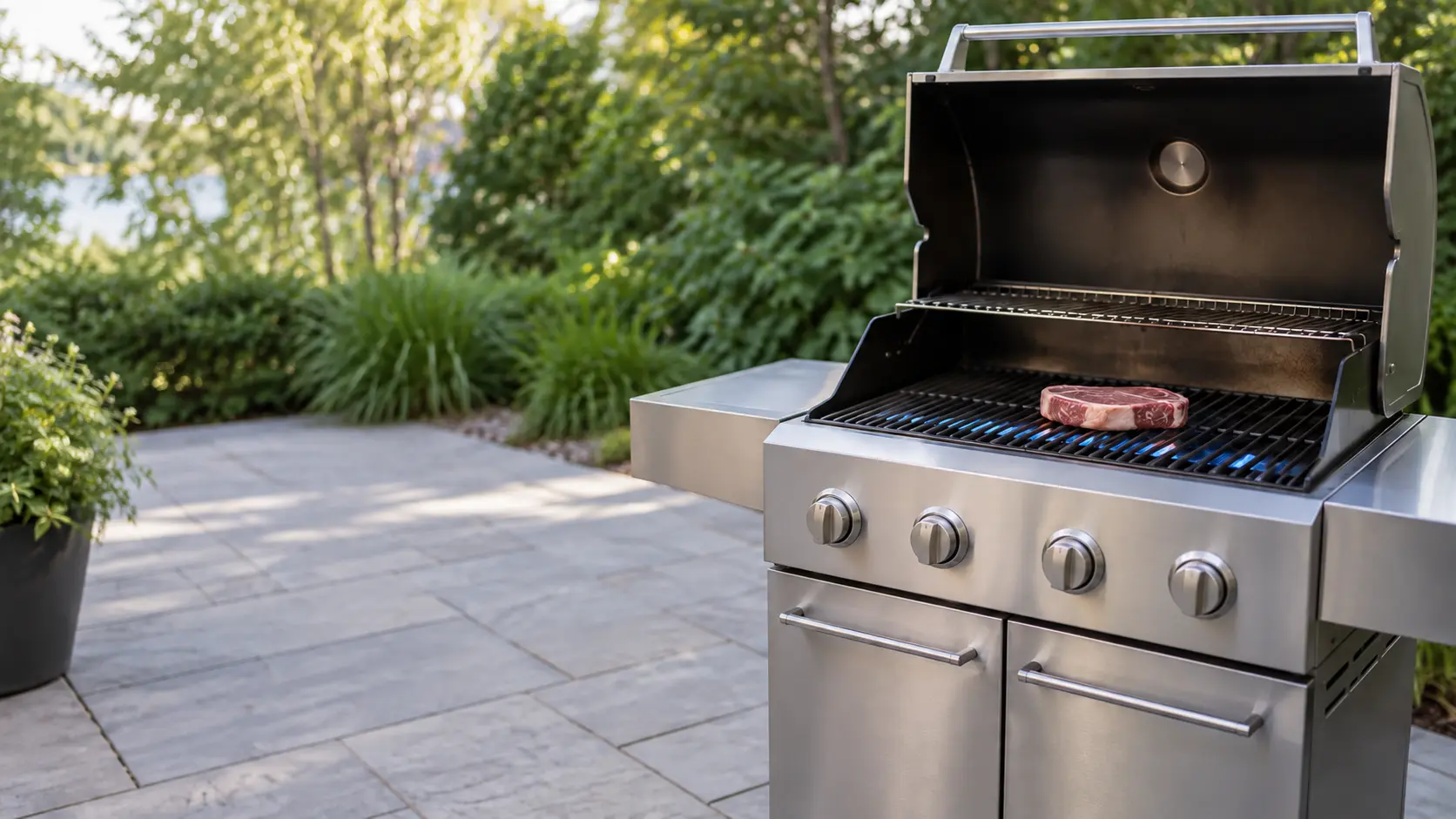
In a standard burner the orifice at each valve shoots gas into the open mouth of a venturi tube, where it pulls in air, and the mixture burns as a row of small blue flames along the burner ports. Most of that heat rises as hot air. Bars, flame tamers or ceramic briquettes above the flames soak some of it up and give it back as radiant heat, which is why the layer between burner and grate matters so much on these grills.
Ceramic infrared grill burners take the same gas and air and force them through a plate pierced with thousands of tiny holes. Lynx explains that the holes concentrate the flame on the face of the element, which glows and throws intense heat straight up at the food, well above what its brass burners reach. Blaze sells a similar sear burner, and Lynx uses the same principle for the infrared burner that spans the back of the hood for the rotisserie.
Glass over the flame: the TEC design
TEC takes a third route. Its Sterling FR grills fire burners beneath radiant glass panels, and drippings vaporize on the glass rather than falling into a flame. The maker's manual claims that ceramic infrared burners cook with roughly one third infrared energy and two thirds hot air, while its glass system cooks with infrared alone. Those percentages are TEC's own, but the design difference is real: there is no open flame under the grate at all.
Source: Lynx — Professional grill care, use and installation manual — Infrared burners focus the flame through a ceramic element with tiny holes, hotter than a brass burner; preheat the ProSear 2 for 2 to 3 minutes until red; food on a cold burner clogs ports; minimize water, no water on flare-ups; dropped grids damage it; run 5 minutes on high after each use and brush ash when cool; remove every 3 to 6 months to inspect venturi and orifice without touching the ceramic; infrared rotisserie burner across the back.
What the difference means at the grate
The obvious gain is speed. A crust forms on a steak in a few minutes over a glowing plate, and TEC's cooking table suggests that food needing about 20 minutes on a conventional grill takes roughly one half to two thirds of that time on its infrared models. The cost is subtlety: a burner designed to glow does not idle as gently as a tube burner turned to low, so fish, vegetables and long cooks are easier over standard flames.
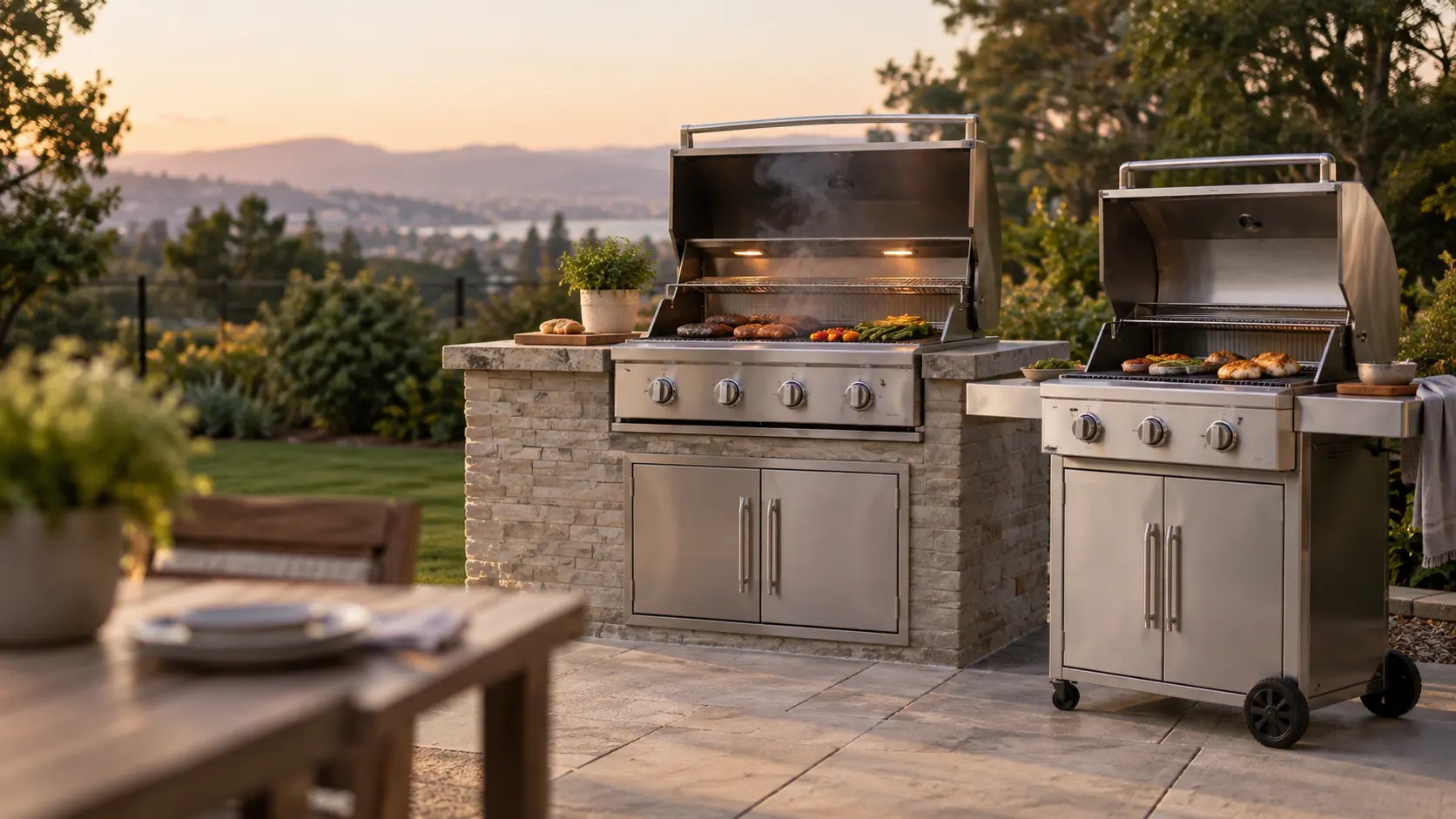
That is why so many grills mix the two. Blaze offers an infrared sear burner as an option that takes the place of the conventional burner on the left, used without the flame tamer above it, and Lynx builds its ProSear 2 into a row of brass burners. You sear on one side and finish on the other.
- Thick steaks, chops and burgers: the infrared station earns its keep.
- Chicken pieces, fish and vegetables: tube burners on medium or low, often with the lid down.
- Roasts on a spit: a rear infrared rotisserie burner, which is a separate part from the main burners.
- Wood smoke: TEC allows dry pellets or small soaked chips directly on its glass panels.
Source: Lynx — Professional grill care, use and installation manual — Infrared burners focus the flame through a ceramic element with tiny holes, hotter than a brass burner; preheat the ProSear 2 for 2 to 3 minutes until red; food on a cold burner clogs ports; minimize water, no water on flare-ups; dropped grids damage it; run 5 minutes on high after each use and brush ash when cool; remove every 3 to 6 months to inspect venturi and orifice without touching the ceramic; infrared rotisserie burner across the back.; Blaze — Professional grill instructional book — Optional infrared sear burner replaces the left conventional burner and is used without the flame tamer; must be seated correctly on the gas valve; preheat 3 minutes with the lid open; clean at high for 5 to 7 minutes with the hood open, soft brush or vacuum when cool.; TEC — Sterling FR and Sterling FR G-Series owner's manual — Radiant glass panels over the burners; maker's claim of about 35 % infrared for ceramic burners versus 100 % for its system; food taking 20 minutes or less cooks in one half to two thirds the time; preheat 13 to 15 minutes for searing, 3 to 5 for slow cooking; never operate without the glass, remove it before moving the grill; 5 to 10 minutes on high after use; wipe cool glass with a damp towel; dry pellets or small soaked chips on the glass; inspect venturi tubes before each use.

Preheating and drippings: the rules infrared adds
The makers are firm about one habit. Lynx says food must never go over its infrared burner until it is fully preheated, because grease and particles landing on a cold element clog the tiny ports and damage the burner. Lynx also warns that its heavy cooking grids will break the burner if dropped on it. Blaze sets a 3-minute preheat with the lid open even when the grill is already hot from cooking.
TEC adds its own conditions for the glass design: the grill is never lit without its radiant glass panels properly seated, and the panels come out before the grill is moved, even when it is only rolled a short way across the patio. For searing, TEC's preheat runs 13 to 15 minutes on high in total; for slow cooking it is 3 to 5 minutes with the hood open.
Why water and a hot plate do not mix
A tube burner shrugs off a splash from a marinade; a hot ceramic plate is another matter. Lynx asks owners to keep water spills off its infrared burner, not to fight flare-ups with water, and to take special care not to drip liquid on it while cleaning the grids above. On a TEC grill the glass is wiped with a damp towel only once it has cooled.
Source: Lynx — Professional grill care, use and installation manual — Infrared burners focus the flame through a ceramic element with tiny holes, hotter than a brass burner; preheat the ProSear 2 for 2 to 3 minutes until red; food on a cold burner clogs ports; minimize water, no water on flare-ups; dropped grids damage it; run 5 minutes on high after each use and brush ash when cool; remove every 3 to 6 months to inspect venturi and orifice without touching the ceramic; infrared rotisserie burner across the back.; Blaze — Professional grill instructional book — Optional infrared sear burner replaces the left conventional burner and is used without the flame tamer; must be seated correctly on the gas valve; preheat 3 minutes with the lid open; clean at high for 5 to 7 minutes with the hood open, soft brush or vacuum when cool.; TEC — Sterling FR and Sterling FR G-Series owner's manual — Radiant glass panels over the burners; maker's claim of about 35 % infrared for ceramic burners versus 100 % for its system; food taking 20 minutes or less cooks in one half to two thirds the time; preheat 13 to 15 minutes for searing, 3 to 5 for slow cooking; never operate without the glass, remove it before moving the grill; 5 to 10 minutes on high after use; wipe cool glass with a damp towel; dry pellets or small soaked chips on the glass; inspect venturi tubes before each use.
Care compared, burner by burner
Every burner type needs the same basic protection: gas off and a cold grill before anything is lifted, and a clear venturi so gas and air arrive in the right mixture. Past that, the routines split.
| Burner | After each cook | Deeper cleaning | What to avoid |
|---|---|---|---|
| Standard tube burner | Burn off on high and brush the grates | Brush the ports and clear the venturi with the gas off and the grill cold | Tools that widen or split the ports |
| Ceramic infrared (Lynx, Blaze) | 5 to 7 minutes on high with the lid open | Soft brush or vacuum for ash once cool; Lynx asks for a venturi and orifice check every 3 to 6 months | Water, dropped grids, touching the ceramic face |
| Radiant glass (TEC) | 5 to 10 minutes on high | Push ash toward the drip tray and wipe the cool glass with a damp towel | Lighting without panels, moving the grill with panels in place |
Spiders ignore the burner type
A glowing plate does not keep insects out of the tube that feeds it. TEC asks owners to inspect its venturi tubes for webs before every use and warns that a clogged tube can start a fire beneath the grill, and Lynx's schedule for its infrared burner includes lifting it out to look at the inlet and orifice for obstructions. When doing so, Lynx says not to touch the ceramic surface.
Source: Lynx — Professional grill care, use and installation manual — Infrared burners focus the flame through a ceramic element with tiny holes, hotter than a brass burner; preheat the ProSear 2 for 2 to 3 minutes until red; food on a cold burner clogs ports; minimize water, no water on flare-ups; dropped grids damage it; run 5 minutes on high after each use and brush ash when cool; remove every 3 to 6 months to inspect venturi and orifice without touching the ceramic; infrared rotisserie burner across the back.; Blaze — Professional grill instructional book — Optional infrared sear burner replaces the left conventional burner and is used without the flame tamer; must be seated correctly on the gas valve; preheat 3 minutes with the lid open; clean at high for 5 to 7 minutes with the hood open, soft brush or vacuum when cool.; TEC — Sterling FR and Sterling FR G-Series owner's manual — Radiant glass panels over the burners; maker's claim of about 35 % infrared for ceramic burners versus 100 % for its system; food taking 20 minutes or less cooks in one half to two thirds the time; preheat 13 to 15 minutes for searing, 3 to 5 for slow cooking; never operate without the glass, remove it before moving the grill; 5 to 10 minutes on high after use; wipe cool glass with a damp towel; dry pellets or small soaked chips on the glass; inspect venturi tubes before each use.
Choosing between them, or taking both
For most households the practical answer is a grill with tube burners and one infrared sear station, or a sear burner fitted later where the maker offers one. An all-infrared grill suits cooks who mostly sear and who are happy with a longer preheat and a stricter cleaning routine.
From the repair side, a ceramic plate is a more delicate and more expensive part than a tube burner, and the usual reasons it fails are a dropped grate, water on a hot face or grease on a cold one. Owners who keep those three away from it rarely need us for that burner.
- Ask whether the infrared burner is sold as a separate part for your model before you buy.
- Check that a sear burner can be swapped without removing the control panel.
- Look for a rotisserie burner if you roast on a spit; it is not the same as a sear station.
- Read the preheat and cleaning pages of the manual in the showroom, not after the first cook.