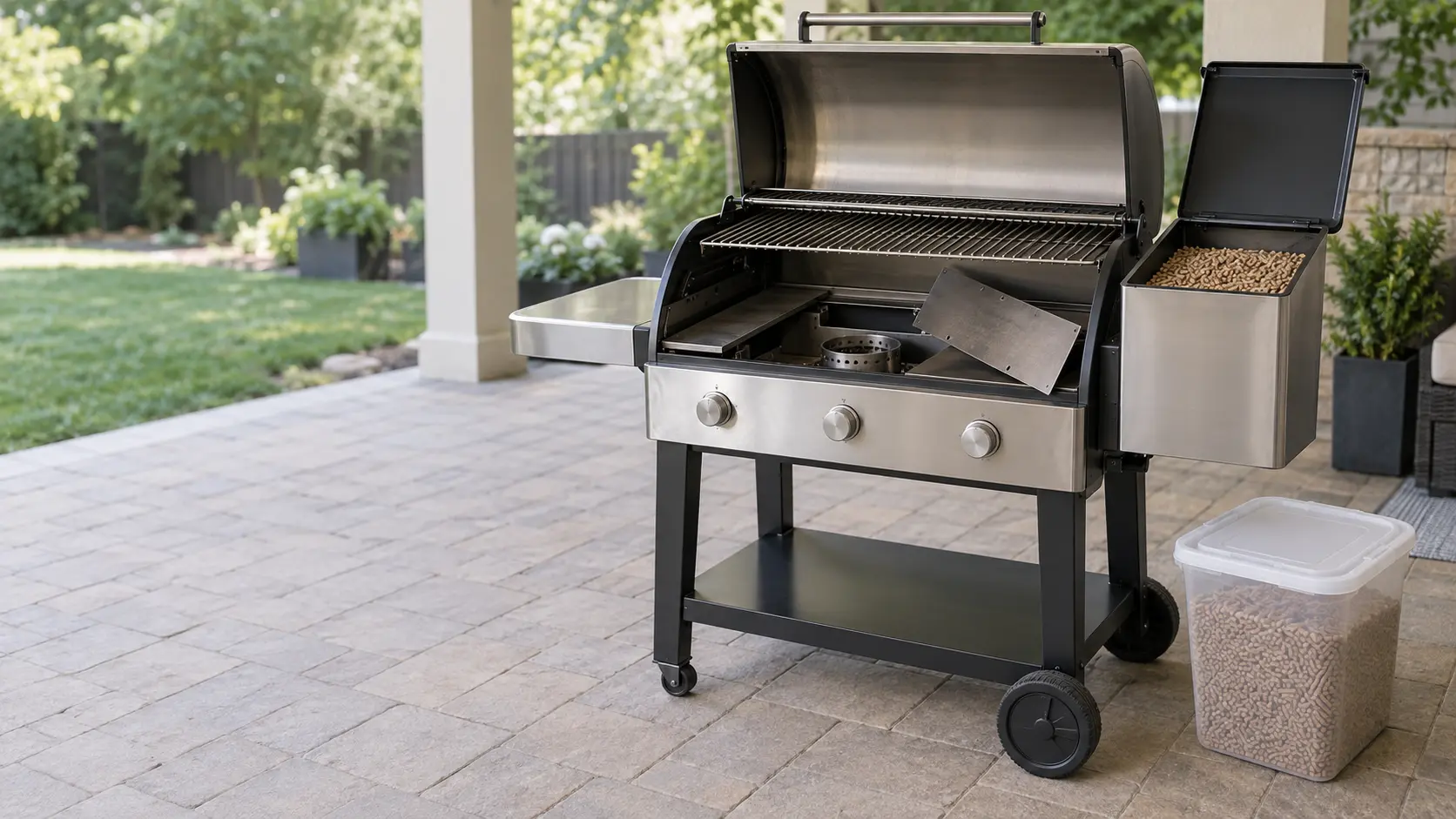


What a pellet grill does with its fuel
Pellets wait in the hopper until an auger, a slowly turning screw in a tube, carries them to the firepot. An igniter rod glows red to light the first load, a fan feeds air to the fire, and the controller reads a temperature probe inside the cookbox and meters the auger to hold the setting. On Coyote's pellet grill the igniter stays on for five minutes at startup by default, and pellets keep feeding for 80 seconds after lighting.
Pellet grill maintenance exists because every one of those parts is sensitive to something ordinary. The auger dislikes swollen pellets, the firepot dislikes ash, the fan dislikes being switched off while the fire is still burning, and the controller can only hold a setting if pellets and air arrive as expected.
Gas-and-pellet hybrids
A hybrid grill pairs gas burners with a pellet or charcoal side. The gas side follows the same care as any gas grill, including burners cleaned with the gas off and the grill cold; the pellet side follows the habits below. Keep the two routines separate so the gas valves are never touched while the pellet side is being cleaned.
Source: Coyote — Stainless steel pellet grill user manual — 100 % natural hardwood pellets, about 8,000 BTU per pound, little ash, 5 to 7 % moisture; store dry in a moisture-proof resealable container, moisture lowers heat or makes pellets swell and break apart; pellets completely dry before startup; igniter on 5 minutes and feeding 80 seconds by default; firepot clear of ash and unburned pellets and firebox free of ash and grease before operating; spilled unburned pellets can be reused; too hot at startup from too many pellets, shutoff from a pot not clear, inspect the burner pot for low or uneven heat; cooldown until 160°F, bypass not recommended; never cover while hot; clean only when cool with power off; drip tray after every use, rain fills an uncovered tray; wash, brush and dry the heat shield periodically; keep grease off the power cord; no foil or sand in the housing; grease fire: close the hood and shut down, no water.
Keeping pellets dry, from the bag to the hopper
Coyote specifies 100 percent natural hardwood cooking pellets, no thicker than a pencil eraser, and describes good ones as burning at about 8,000 BTU per pound with very little ash and a moisture content of 5 to 7 percent. The maker's storage advice is short: keep them in a dry place, away from any contact with moisture, in a moisture-proof resealable tub or bucket. Pellets that absorb water give less heat or swell and break apart.
A torn bag left on a damp garage floor or a hopper left full on an uncovered grill through a rainy week is the usual way pellets get wet. Coyote also asks that pellets be completely dry before a startup.
- A layer of sawdust at the bottom of the bag or hopper.
- Pellets that bend or crumble instead of snapping cleanly.
- Swollen or split pellets, or a musty smell.
- Startups that take longer than usual or fail.
When wet pellets have reached the auger
Swollen pellets can pack the auger tube so tightly that the motor stalls. Unplug the grill, empty the hopper of anything damp and do not reach into the hopper throat or the feed tube to dig them out. A jammed auger is a job for a visit, where the tube can be cleared without straining the motor.
Source: Coyote — Stainless steel pellet grill user manual — 100 % natural hardwood pellets, about 8,000 BTU per pound, little ash, 5 to 7 % moisture; store dry in a moisture-proof resealable container, moisture lowers heat or makes pellets swell and break apart; pellets completely dry before startup; igniter on 5 minutes and feeding 80 seconds by default; firepot clear of ash and unburned pellets and firebox free of ash and grease before operating; spilled unburned pellets can be reused; too hot at startup from too many pellets, shutoff from a pot not clear, inspect the burner pot for low or uneven heat; cooldown until 160°F, bypass not recommended; never cover while hot; clean only when cool with power off; drip tray after every use, rain fills an uncovered tray; wash, brush and dry the heat shield periodically; keep grease off the power cord; no foil or sand in the housing; grease fire: close the hood and shut down, no water.

The firepot, the ash and a clean startup
Coyote asks, before the grill is operated in any capacity, that the firepot be clear of ash and unburned pellets and that the firebox be free of ash and grease. Pellets that spill into the pot while the hopper is being filled should be taken out; if they have not burned, they can go back in the hopper. How the ash is lifted out depends on the model, so use the method your own manual describes, with the grill cold and unplugged.
The troubleshooting table explains why this matters. A grill that runs far hotter than set at startup may have had too many pellets in the pot when it lit; a grill that shuts itself off needs its pot checked for leftover pellets and buildup; and one that will not get hot or heats unevenly is a reason to inspect the burner pot.
Never reach into a warm firepot
Ash hides embers long after the display goes dark. Coyote's rule that all cleaning is done with the grill cool and the power off exists for exactly this reason. If the pot is still warm, close the lid and come back later.
Source: Coyote — Stainless steel pellet grill user manual — 100 % natural hardwood pellets, about 8,000 BTU per pound, little ash, 5 to 7 % moisture; store dry in a moisture-proof resealable container, moisture lowers heat or makes pellets swell and break apart; pellets completely dry before startup; igniter on 5 minutes and feeding 80 seconds by default; firepot clear of ash and unburned pellets and firebox free of ash and grease before operating; spilled unburned pellets can be reused; too hot at startup from too many pellets, shutoff from a pot not clear, inspect the burner pot for low or uneven heat; cooldown until 160°F, bypass not recommended; never cover while hot; clean only when cool with power off; drip tray after every use, rain fills an uncovered tray; wash, brush and dry the heat shield periodically; keep grease off the power cord; no foil or sand in the housing; grease fire: close the hood and shut down, no water.
Letting the shutdown cycle finish
On a Coyote pellet grill, pressing stop halts the auger and speeds up the fan, and a cooldown mode runs until the grill reads 160°F inside. Only then does the fan stop, and only then should the power button be pressed. The manual includes a button to skip the cooldown for anyone who wants to keep cooking, but does not recommend using it to end a cook.
Cutting power in the middle of that cycle leaves half-burned pellets in the pot with no fan to finish them, which is how the next startup begins with a pot already partly full. Coyote also warns never to put a cover on a grill that is still hot, because the cover itself can catch fire.
Source: Coyote — Stainless steel pellet grill user manual — 100 % natural hardwood pellets, about 8,000 BTU per pound, little ash, 5 to 7 % moisture; store dry in a moisture-proof resealable container, moisture lowers heat or makes pellets swell and break apart; pellets completely dry before startup; igniter on 5 minutes and feeding 80 seconds by default; firepot clear of ash and unburned pellets and firebox free of ash and grease before operating; spilled unburned pellets can be reused; too hot at startup from too many pellets, shutoff from a pot not clear, inspect the burner pot for low or uneven heat; cooldown until 160°F, bypass not recommended; never cover while hot; clean only when cool with power off; drip tray after every use, rain fills an uncovered tray; wash, brush and dry the heat shield periodically; keep grease off the power cord; no foil or sand in the housing; grease fire: close the hood and shut down, no water.
Grease, rain and the cover
Coyote recommends cleaning the drip tray after every use. Left uncovered in rain, the tray fills with water and spills grease and water into the cart. The heat shield over the firepot does not need washing after every cook, but periodically it gets a wash in warm soapy water once cool, a wire brush for stubborn residue, and a thorough drying before it goes back.
Keep grease off the power cord and away from the plug, as the maker warns, and never line the bottom of the housing with foil, sand or anything absorbent, which stops grease reaching the tray and can lead to a grease fire. If grease does catch, Coyote says to close the hood and shut the grill down until the grease burns out, never to use water, and to take care when opening the hood again; call 911 if the fire spreads beyond the grill.
- After every cook: cooldown finished, drip tray emptied, cover on once cold and dry.
- Every few cooks: firepot and firebox cleared of ash, grates cleaned.
- Monthly in season: heat shield washed and dried, hopper emptied and checked for dust.
- Before storage: hopper emptied completely, pellets moved into a sealed tub.
Source: Coyote — Stainless steel pellet grill user manual — 100 % natural hardwood pellets, about 8,000 BTU per pound, little ash, 5 to 7 % moisture; store dry in a moisture-proof resealable container, moisture lowers heat or makes pellets swell and break apart; pellets completely dry before startup; igniter on 5 minutes and feeding 80 seconds by default; firepot clear of ash and unburned pellets and firebox free of ash and grease before operating; spilled unburned pellets can be reused; too hot at startup from too many pellets, shutoff from a pot not clear, inspect the burner pot for low or uneven heat; cooldown until 160°F, bypass not recommended; never cover while hot; clean only when cool with power off; drip tray after every use, rain fills an uncovered tray; wash, brush and dry the heat shield periodically; keep grease off the power cord; no foil or sand in the housing; grease fire: close the hood and shut down, no water.


