
What really differs between a built-in and a cart grill
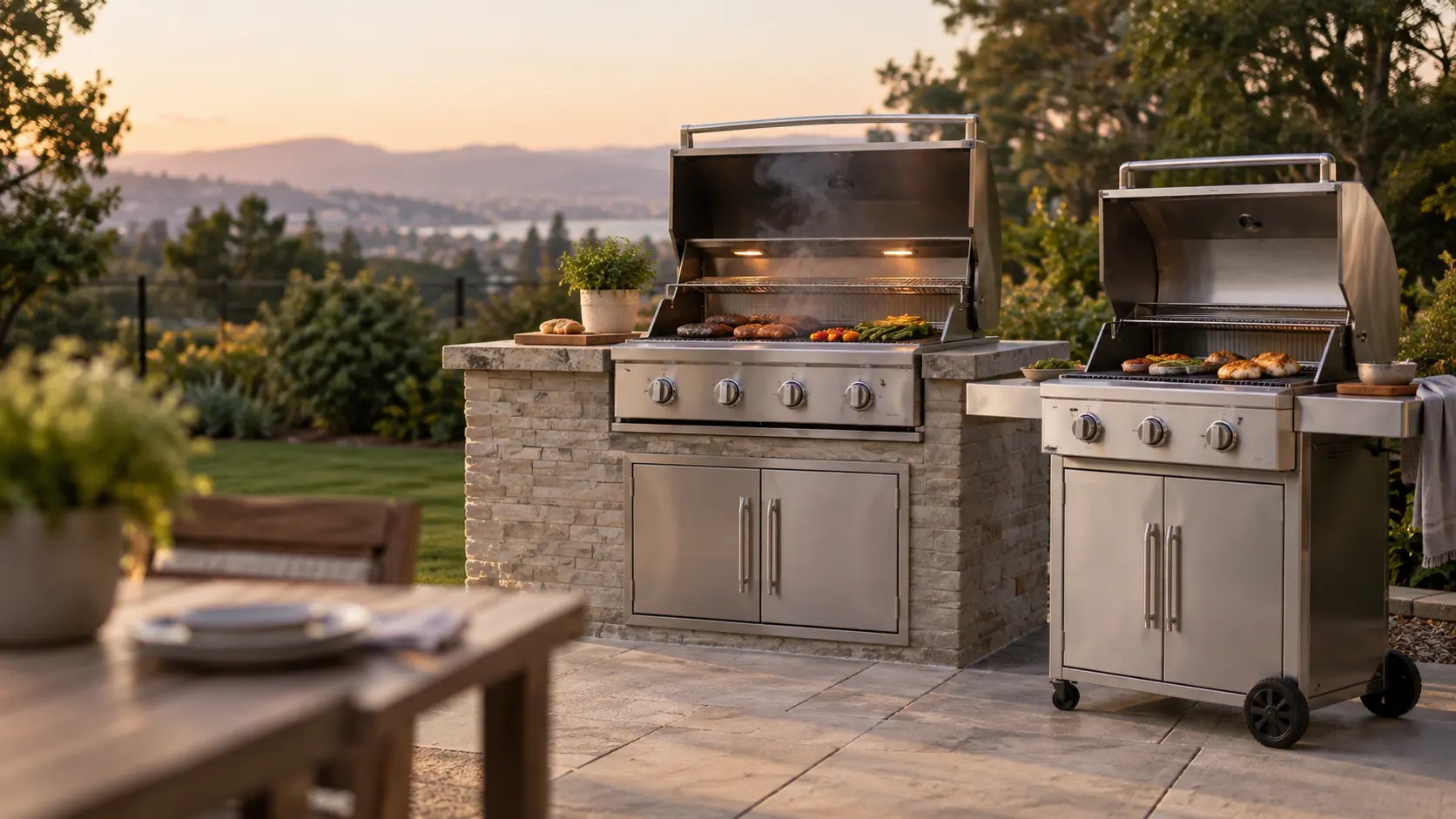
Lift the hood on a premium grill and the cookbox often looks identical whether it hangs in stone or rides on casters. Lynx, Blaze, Coyote and several other makers sell one head that either drops into a counter opening or bolts onto a matching cart. The burners, the heat shields and the valve manifold have no idea where they have been mounted, so picking a built-in or freestanding grill is rarely a decision about cooking.
What changes is everything around that head: the material of the enclosure, the route the gas takes and where a leak could collect, how the wind reaches the burners, and how easily someone can get to the parts behind the control panel. Those four questions decide more about the next decade of ownership than the badge on the lid, so they are the ones this guide works through.
When one head is sold both ways
If you are weighing a built-in head against its cart version, ask the dealer for both installation sheets before you choose. The cart usually adds a frame, wheels, a tank shelf and doors while the cooking hardware stays the same, which means the real decision is about your patio, your gas supply and your plans for the house rather than about searing power.
What a built-in grill head asks of the island
Lynx designs its built-in grills for an enclosure made of non-combustible materials, where the head simply hangs from its counter trim with no deck beneath it. In a combustible enclosure the maker requires its own insulated jacket, and the jacket must rest on ledges or a full deck. Blaze is stricter in wording: its islands must be built of non-combustible material, and a jacket becomes mandatory whenever they are not.
Clearances follow the same logic. Lynx wants 12 in. between the sides and back of the grill and any combustible construction below the counter, 18 in. to anything combustible that rises above it, and 3 in. behind the head so the hood can open. Blaze asks for 18 in. at the sides and back and 5 in. for its lid. Neither maker allows the grill under an unprotected combustible roof or overhang, and Lynx adds that a head exposed to steady wind should get a wind barrier.
- An island of block, stone, or steel studs with cement board, or the maker's insulated jacket in a wood-framed one.
- Vent openings in the island walls, placed low for propane and high for natural gas.
- A grounded GFCI outlet within reach for lights, igniters or a rotisserie motor; Lynx specifies a 120-volt, 15-amp circuit put in by an electrician.
- An access door under the head big enough to reach the gas shutoff quickly.
- Open sky above the grill, or a vent hood where a maker allows cover overhead.
Vents for gas that has nowhere else to go
A closed island is a box, and a leak inside it has nowhere to escape. Blaze asks that every island with a gas grill be ventilated in some way and explains why the vents move with the fuel: propane is heavier than air and settles at the bottom of the cavity, while natural gas is lighter and gathers at the top. A propane cylinder kept inside the island needs a plenum wall separating it from the rest of the cabinet, or a dedicated tank drawer. Lynx makes the same point more briefly: the enclosure needs ventilation holes so leaked gas cannot build up.
Source: Lynx — Professional grill care, use and installation manual — Built-ins for non-combustible enclosures or combustible ones with a Lynx insulated jacket on ledges or a deck; clearances 12 in. below and 18 in. above the counter, 3 in. behind for the hood; no overhead combustible construction; wind barrier for built-ins; 120 V 15 A GFI outlet by an electrician; ventilation holes in the enclosure; out-of-level grills heat unevenly and carts may need re-leveling after each move; freestanding units face the wind into the control panel; quick-disconnect kit for natural gas carts; close the cylinder after use and keep it outdoors; shipping weights about 300 lb. to over 500 lb.; Blaze — Professional grill instructional book — Islands must be non-combustible or use an insulation jacket; 18 in. clearance at sides and back and 5 in. behind for the lid; every island ventilated, low for propane and high for natural gas; plenum wall or tank drawer for a cylinder inside the island; burners held by rear cotter pins often removed before installation; do not seal around the control panel.

What a cart grill asks of the patio
A freestanding grill trades masonry for mobility, and mobility brings its own chores. Lynx points out that a grill out of level burns erratically and heats unevenly, and that on a sloped patio the cart may need leveling again every time it moves.
Fuel is the other habit. A propane cart should have its cylinder valve closed after every cook, as Lynx asks, and the CPSC warns against keeping a spare cylinder under or near the grill or using or storing one indoors. If the grill spends winter in a garage, the cylinder stays outside in open air. A cart on natural gas is best fed through a quick-disconnect kit, which Lynx strongly recommends so the grill can be unhooked and rolled without touching a fitting.
Why the wind matters more on wheels
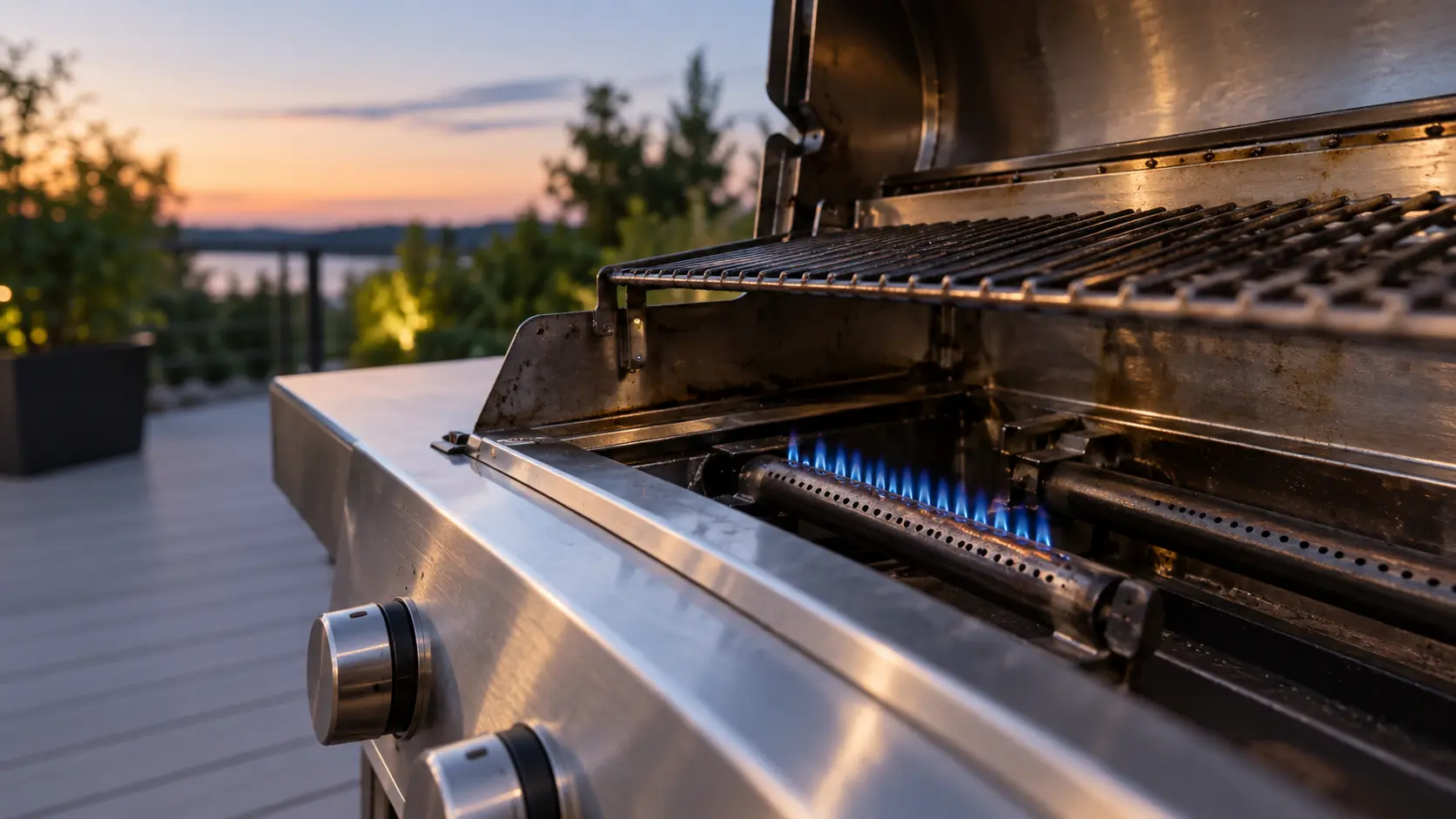
A gas grill breathes in at the front, under the control panel, and pushes hot combustion gases out at the back. Lynx asks owners of freestanding grills to turn them so the prevailing wind blows into the control panel, at the cook's back, and warns that wind striking the rear of the grill or running along the hood gap causes trouble. A cart can simply be turned to suit the breeze; a built-in head is fixed, which is why it needs a barrier instead.
Source: Lynx — Professional grill care, use and installation manual — Built-ins for non-combustible enclosures or combustible ones with a Lynx insulated jacket on ledges or a deck; clearances 12 in. below and 18 in. above the counter, 3 in. behind for the hood; no overhead combustible construction; wind barrier for built-ins; 120 V 15 A GFI outlet by an electrician; ventilation holes in the enclosure; out-of-level grills heat unevenly and carts may need re-leveling after each move; freestanding units face the wind into the control panel; quick-disconnect kit for natural gas carts; close the cylinder after use and keep it outdoors; shipping weights about 300 lb. to over 500 lb.; CPSC — Gas grill safety fact sheet (Publication 467) — Never store a spare LP container under or near the grill; never use or store an LP container indoors.
How each grill is reached when a part wears out
Burners, igniters, valves, hoses and regulators wear out on both kinds of grill at about the same pace. What differs is access. On a cart the technician rolls the grill into good light, opens the cabinet doors and sees the manifold, the gas line and the igniter module from below. On a built-in head the same work is done from above and through whatever access door the island has.
Small details made at installation decide how long that takes. Blaze secures each burner with cotter pins at the bottom rear, reached from behind the grill head, and notes that installers often pull those pins before the head goes into an island, because nobody can reach them afterward. Blaze also asks that nothing be sealed around the control panel, since the panel has to come off for service.
Replacing the whole grill years from now
A worn-out cart grill leaves on its own wheels and a new one rolls into the same spot. A built-in head is tied to the size of its opening, and its replacement has to match that cutout or the counter has to be reworked. It is heavy as well: Lynx lists shipping weights of about 300 lb. for its smaller grills and more than 500 lb. for the larger ones, which makes lifting a head out of an island a job for a crew rather than a pair of neighbors.
Source: Blaze — Professional grill instructional book — Islands must be non-combustible or use an insulation jacket; 18 in. clearance at sides and back and 5 in. behind for the lid; every island ventilated, low for propane and high for natural gas; plenum wall or tank drawer for a cylinder inside the island; burners held by rear cotter pins often removed before installation; do not seal around the control panel.
Matching the grill to how you cook and where you live
No single answer suits every yard, but a few situations point clearly one way or the other.
- Renting, or planning to sell within a few years: a cart grill leaves with you.
- Salt air or a pool close by: either kind needs regular wiping, but a cart can be rolled under a roof or into a garage once the cylinder is outside.
- Cooking for a crowd most weekends: a built-in head gives you counter space on both sides for platters and prep.
- Natural gas already at the house: a built-in can be hard-piped with its own shutoff, and a cart can use a quick-disconnect hose.
- A wind tunnel between two houses: a cart turned so the breeze hits the control panel, or a built-in with a proper barrier.