
Parts a grill is designed to lose
Heat, grease and weather wear out a predictable set of parts, and makers plan for it: each of these sits on a ledge, a pin or an orifice and is sold separately. Replacing one, or several, is routine and rarely a reason to give up on a grill whose cookbox is sound.
It helps to know what the end of each part looks like, so you can describe it when you call and so a repair visit arrives with the right box in the van.
- Cooking grates: porcelain flaking away in sheets, or cast iron pitted through.
- Flavorizer bars, flame tamers and heat shields: holes, sagging, or rust flakes dropping onto the burners.
- Ceramic briquette trays: cracked trays or briquettes crumbling into gaps.
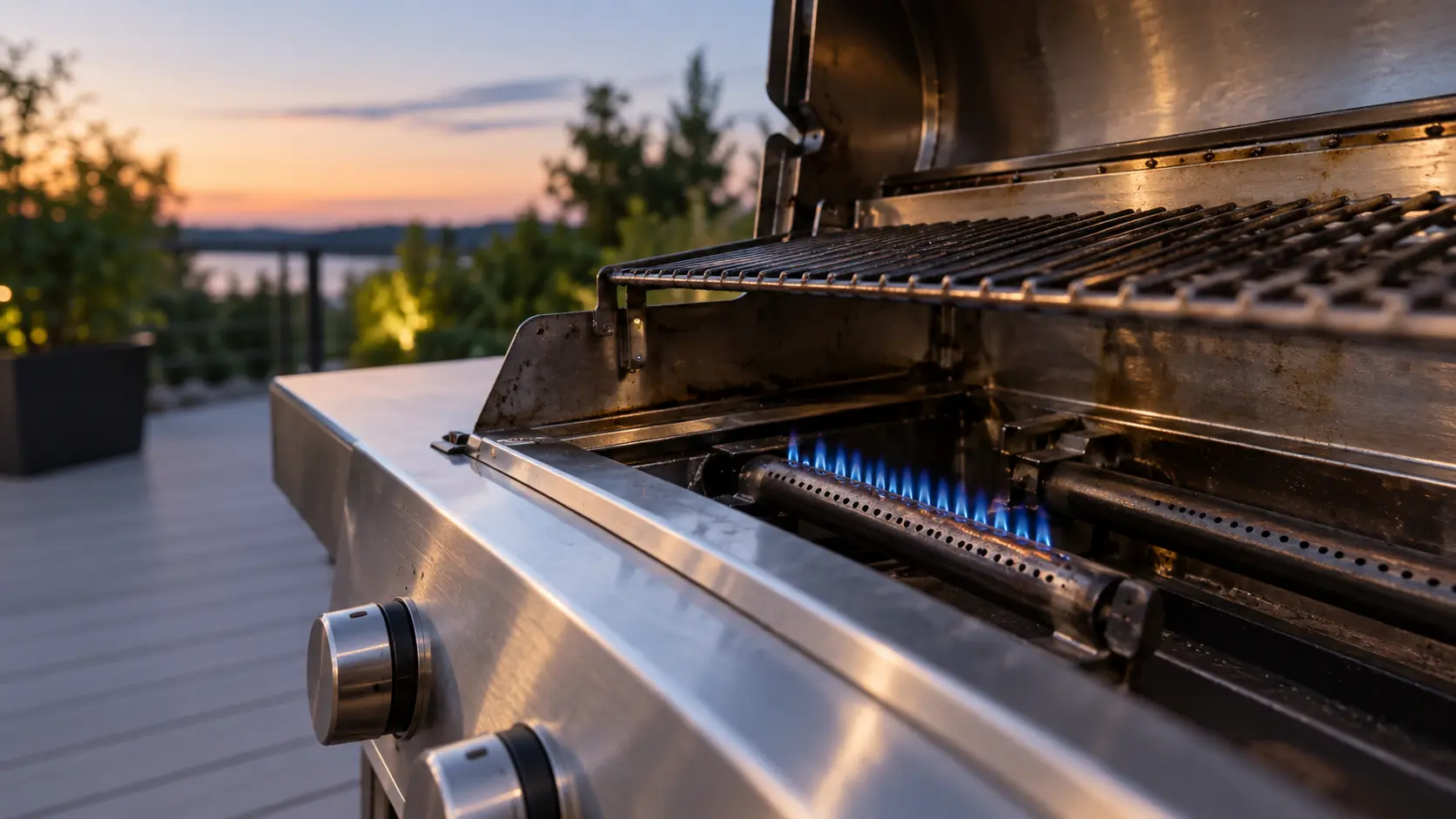
- Burners: ports merged into slots, split seams, or scale that returns right after a scraping.
- Igniters: a cracked white insulator on the electrode, a loose wire, or a module that only clicks with a fresh battery.
- Hoses and regulators: the CPSC signs of cracking, brittleness, holes, leaks or sharp kinks.
- Knobs, bezels, lights and rotisserie motors: worn, faded or quiet, all bolt-on parts.
Why burners are usually first to go
A burner lives under the drippings, at full heat, for its whole life. Lynx tells owners to scrape stubborn scale from its brass burners and clear blocked ports with a straightened paper clip, which keeps a good burner going. Once the metal between the ports has rusted away, though, the flame runs together and burns unevenly, and scraping only removes more of what is left. At that point the burner is a part to order, not a sign that the grill is finished.
Source: CPSC — Gas grill safety fact sheet (Publication 467) — Check hoses for cracking, brittleness, holes, leaks and sharp bends; leak check with one part water and one part liquid detergent at connections with the LP valve open; if tightening does not stop bubbles, close the container valve and take the grill to an LP dealer or qualified repair person.
When the repair stops making sense
The cookbox and the manifold are different. The cookbox holds every other part in place, and the manifold carries the valves that meter gas to each burner. When either fails, the repair means stripping the grill down to its frame, and on many models the part is expensive or no longer made. These are the conditions that usually lead us to suggest a replacement.
- A firebox floor rusted through, letting grease fall into the cart or onto the hose.
- A cracked cast cookbox or lid.
- Valves that stick, leak or will not turn off, on a model whose manifold is out of production.
- A grill that has been through a serious grease fire, with warped panels and scorched wiring.
- Several major parts worn out at once on a cookbox that is itself thinning.
Rust on the surface versus rust through the metal
Brown spots are not a verdict. Lynx notes that chlorine from pools and salt from sea air can cause surface rust and even pitting on its 304 stainless steel if left in place, and that heat discoloration after the first cooks is normal and permanent. Its limited lifetime terms cover rust-through of parts that make the grill inoperative, not surface rust or staining from the environment. If a wipe with a stainless cleaner brings the steel back, the grill is fine; if a flake lifts away and light shows beneath it, the metal has gone.

Why a built-in grill tilts toward repair
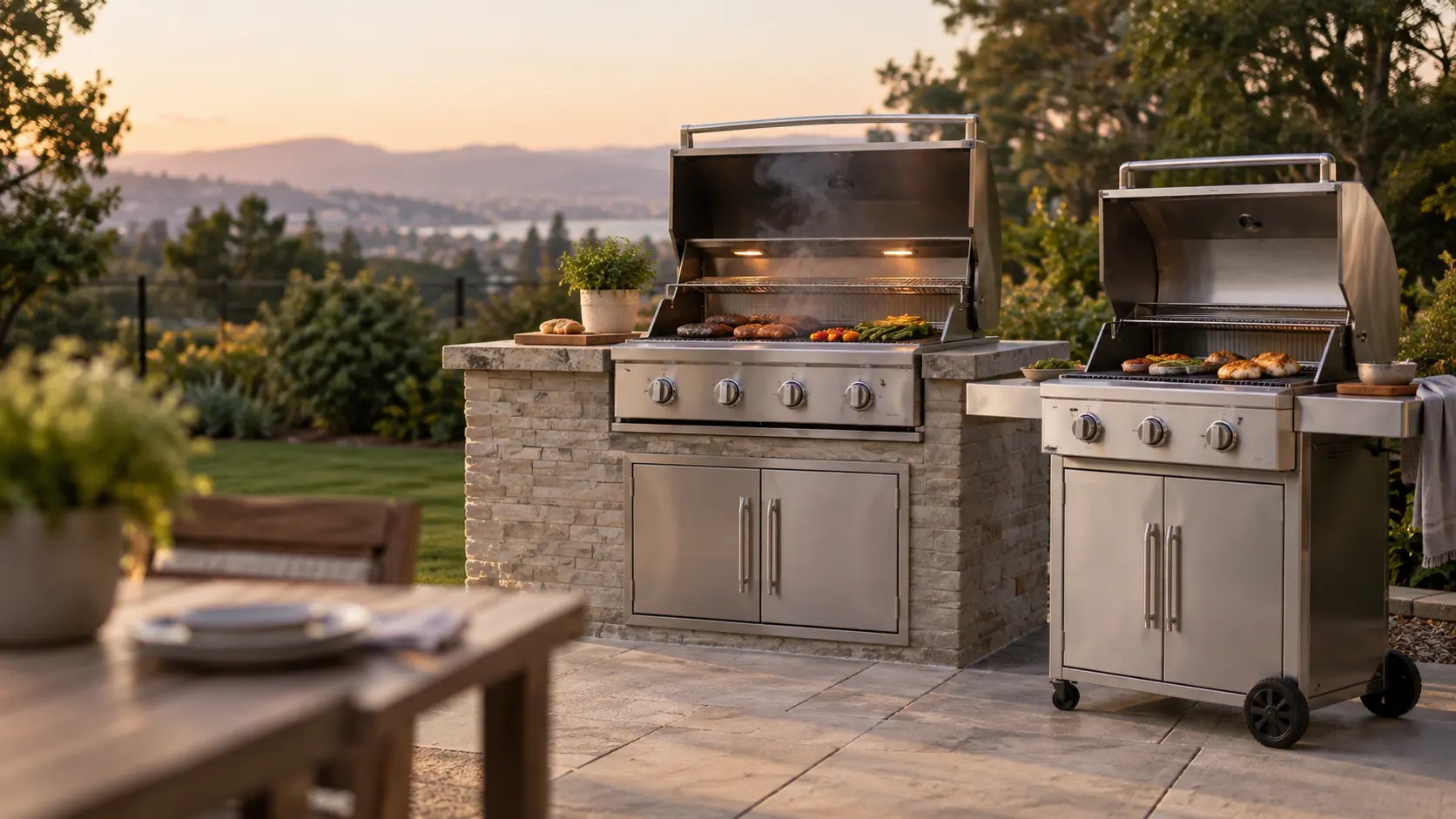
A cart grill that has reached the end can be swapped in an afternoon. A built-in head is anchored to a stone or block opening, sometimes to an insulated jacket sized for that exact model, and to a gas line routed to its manifold. Replacing it means finding a new head that fits the cutout or paying for masonry work as well, plus the effort of lifting the old one out; Lynx lists shipping weights from about 300 lb. to more than 500 lb.
That changes the arithmetic. A repair that would be borderline on a cart grill, such as a new manifold, is often sensible on a built-in head whose cookbox is still sound, because the alternative includes the counter.
Matching a new head to an old opening
Cutout sizes vary between makers and sometimes between model years from one maker. Before ordering, measure the opening width, depth and height, note where the gas line enters, and check whether the island is combustible. Lynx designs its insulated jackets for its own grills, so a jacketed island may commit you to that brand or to a new jacket.
Source: Lynx — Professional grill care, use and installation manual — Scrape burner scale with a metal scraper and clear ports with a straightened paper clip; pool chlorine and salt air can cause surface rust and pitting on 304 stainless; heat discoloration is normal; lifetime terms cover rust-through that renders the product inoperative, not surface rust or staining; parts replaced with the owner paying labor; insulated jackets designed for Lynx grills; shipping weights about 300 lb. to over 500 lb.
Questions to answer before you pay for either
Whether you repair or replace a gas grill, a few facts settle the choice quickly, and you can gather them yourself with the gas off.
- The model and serial number from the rating label, so parts can be looked up.
- Whether the maker still supplies burners, valves and igniters for that model.
- The fuel it is set up for, since a new grill on the other gas needs the maker's conversion.
- What the maker's terms still cover; Lynx, for example, supplies defective parts and leaves labor to the owner.
- The condition of the firebox floor and the lid, checked with a flashlight.
- How many other wear parts are close to the end.
Source: Lynx — Professional grill care, use and installation manual — Scrape burner scale with a metal scraper and clear ports with a straightened paper clip; pool chlorine and salt air can cause surface rust and pitting on 304 stainless; heat discoloration is normal; lifetime terms cover rust-through that renders the product inoperative, not surface rust or staining; parts replaced with the owner paying labor; insulated jackets designed for Lynx grills; shipping weights about 300 lb. to over 500 lb.
What a diagnostic visit settles
A technician checks what an owner cannot: gas pressure at the manifold, whether each valve opens and closes cleanly, how the burners sit on their orifices, and whether the firebox and frame will carry new parts. The visit ends with a list of what failed, what is available and how the repair compares with a new grill of the same size.
The spread is wide. The cheapest repairs are batteries, an electrode or a set of grates; burners and heat shields sit in the middle; a valve manifold on a large built-in head is at the far end. Knowing which of those you face is most of the decision.
Leak checks stay simple for owners
The CPSC describes the one leak check an owner makes: with the propane cylinder valve open, brush a mix of equal parts water and liquid detergent over the connection and watch for bubbles. If tightening the connection does not stop them, close the cylinder valve and have a dealer or repair person look at the grill before it is lit again. Opening fittings, removing valves and holding a flame near a joint are never part of it.