
How big a gas grill do you really need?
Pick gas grill size by the number you usually feed, then add room for the way you like to cook. A grill is sized by its primary cooking area, the grate surface under the lid, and not by the number of knobs on the front.
Match the grill to the household
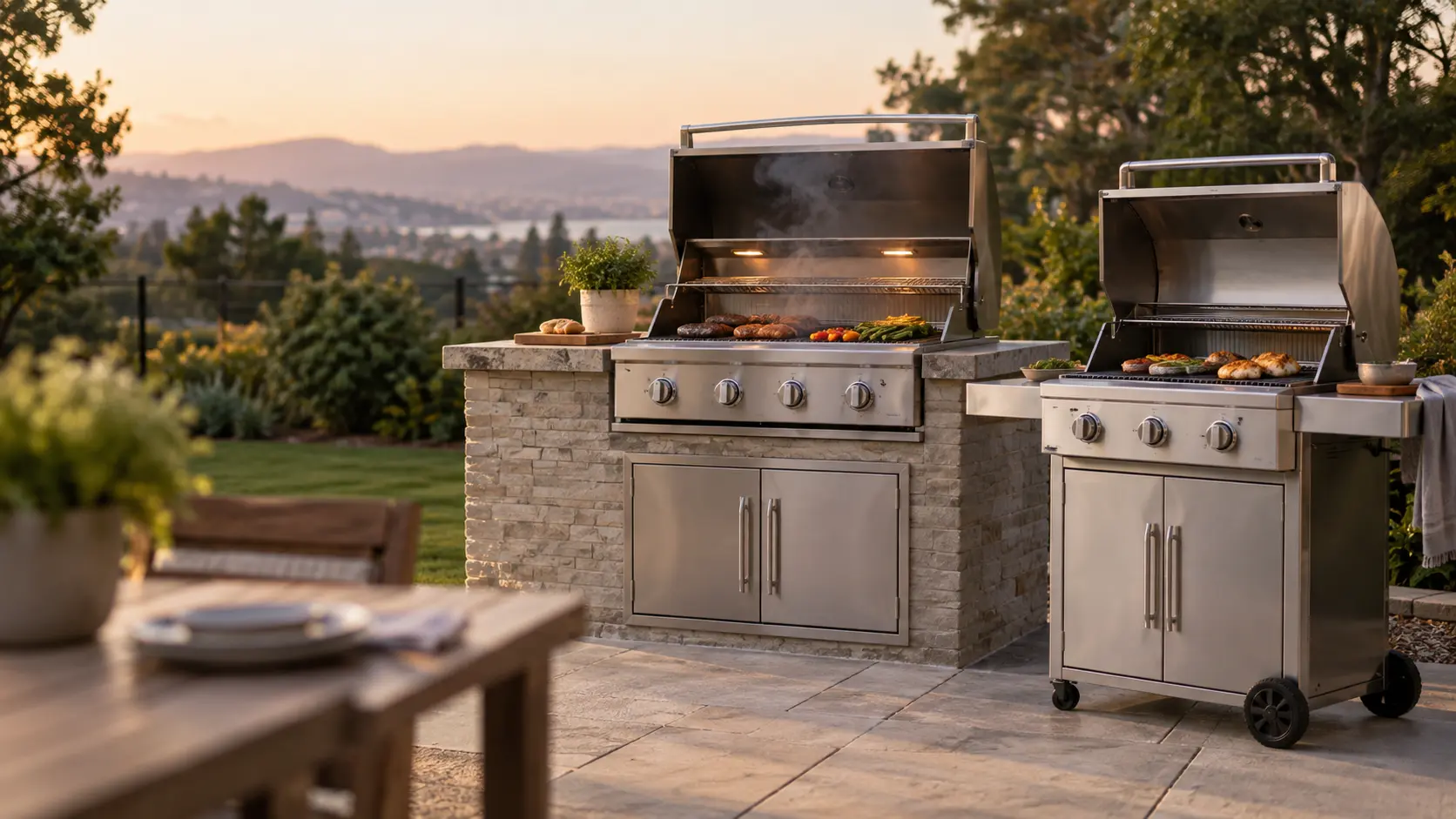
- Two to four people, weeknight meals: a compact or two-to-three burner grill covers it.
- A family of four to six that cooks several items at once: three to four burners gives room for a hot side and a cool side.
- Frequent hosting with large cuts, sides and a warming area: four or more burners, or a large primary area with side burners.
These are guides, not rules. A big grill that you rarely fill wastes gas heating empty grate, and a small one that is always crowded cooks unevenly.
Primary area versus warming rack
Some listings add the warming rack and side shelf to the cooking area to make the grill look larger. Read the specifications for the primary cooking area, since that is the area that is hot.
Does burner count matter, or is BTU per square inch better?
BTU per square inch of cooking area is a better yardstick than burner count, because a five-burner grill with weak burners can be less powerful than a three-burner with strong ones. A BTU is a unit of heat output; the rating label lists the total, and the specifications list the area.
How to compare two models
Divide the total BTU rating of the main burners by the primary cooking area in square inches. The higher the figure, the more heat per square inch of grate. Compare only like with like: some makers include side burners or a rear rotisserie burner in the total, which inflates it. A grill with a low ratio for its size heats more slowly and loses more ground in cold weather or wind, one of the reasons owners search for a grill not getting hot. There is no official target figure, so use the ratio to compare the grills in front of you rather than to chase a number.
Undersized or faulty?
If a grill that used to reach searing heat no longer does, its size has not changed: the usual causes are clogged burner ports, spider webs in the venturi tubes, worn heat shields or a gas supply problem, and the problem page above walks through them. A grill that has never heated well on a calm day, with clean burners and a full tank, is more likely too large for its burners.
Fuel type and pressure
Natural gas and propane have different pressures and orifice sizes, and the label states which one the grill is built for. Converting is a gas job; see converting propane to natural gas and use a qualified installer or your gas utility.
Table: What to read on a grill's specifications
| Item | Where to find it | What it tells you |
|---|---|---|
| Total BTU | Rating label and spec sheet | Maximum heat from all listed burners |
| Primary cooking area | Spec sheet | The grate area under the lid |
| Burner count and control | Front panel, spec sheet | How many zones you can set |
| Fuel type | Rating label | Propane or natural gas, not interchangeable |

Why does two-zone cooking change the answer?
Two-zone cooking, with one side hot and one side low or off, needs burners you can control in separate groups. With two burners you can do it, but the cool zone is small; with three or more, you get a wider cool zone for resting food and indirect cooking.
What to look for
- Controls that set each burner independently, not a single master dial.
- Burners spaced evenly across the firebox, so there are no cold strips between them.
- A lid that closes tightly, which makes indirect cooking possible.
- Heat shields or flavorizer bars that spread heat; see heat shields, flavorizer bars and briquettes.
A grill that cooks hot on one side and cold on the other is the problem described in why one side runs cold. That is a symptom of burner or shield trouble, not of the size you chose.
Infrared and side burners
An infrared sear station is a high-heat zone for steaks, and it adds one more thing to maintain. If you are weighing it, read infrared or standard burners.
What do more burners mean for parts and upkeep later?
More burners mean more of everything that wears out: burners, igniters, valves, heat shields and grates. The cost is not only the purchase price, since burners and shields wear out at a pace set by use, weather and cleaning.
Parts that scale with burner count
- One burner, igniter and valve for each control knob.
- One heat shield or bar set per burner.
- Wider grates and more surface to clean.
- A larger lid and firebox that needs more room.
A grill burner replacement or heat shield and grate replacement is simple on a common design, but a rare or discontinued part can make a large grill hard to keep. Ask how long the maker stocks parts. If a grill is already aging, see repair or replace a grill.
How do you fit the grill to your space?
A bigger grill needs a bigger safe area around it. The rating label or manual gives clearances to walls, railings and overhead covers, and a large grill moves the hot edges outward. See clearances around a grill and the rating label before you buy.
Before you buy
- Measure the space with the lid open and the side shelves up.
- Check the clearance distances in the manual for your model.
- Confirm where the tank or gas connection goes.
- Ask what happens if the grill must be moved; a heavy cart is difficult on steps.
If you are unsure whether an existing grill is big enough or healthy enough, a diagnostic visit can check heat output and the gas train, with any gas work left to a qualified installer.