
Which smell is it, and how worried should I be?
Gas is the only smell on this list that calls for stopping at once; the rest are housekeeping. Run through the table before you touch anything.
| Smell | Most likely source | First move |
|---|---|---|
| Sharp, rotten egg or cabbage | Gas at a joint, a burner left open, or an unlit burner that filled the firebox | Knobs off, tank valve or shutoff closed, lid open, step away |
| Stale, rancid, like old fryer oil | Grease on the tray, the grates and the firebox floor | Cool it, scrape and wash |
| Acrid, sharp smoke from a cold start | Old carbon and drippings burning off the burners and bars | Burn-off, then brush |
| Melting plastic or rubber | A knob, hose, cover or panel part too close to heat | Shut down and let it cool, then inspect |
| Musty, like a damp basement | Moisture and mildew under a cover or inside a closed lid | Dry out, wash, leave the lid vented |
| Fishy or sour on the grates | Marinade and food residue cooked on | Scrub grates, wash with warm soapy water |
Why the gas smell is treated differently
Propane and natural gas are odorless in themselves, and suppliers add the strong smell on purpose so a leak is noticed early. On an open patio a breeze can thin it out, which is why people shrug it off. Do not. The page on a gas smell from a grill walks through that case in detail; this guide covers everything around it. If the grill also flares up while you cook, see flare-ups.
Source: CPSC — Safety checks for the gas grill (fact sheet) — the soapy-water leak check (one part water, one part liquid detergent) and the hose inspection
What do I do when the smell is gas?
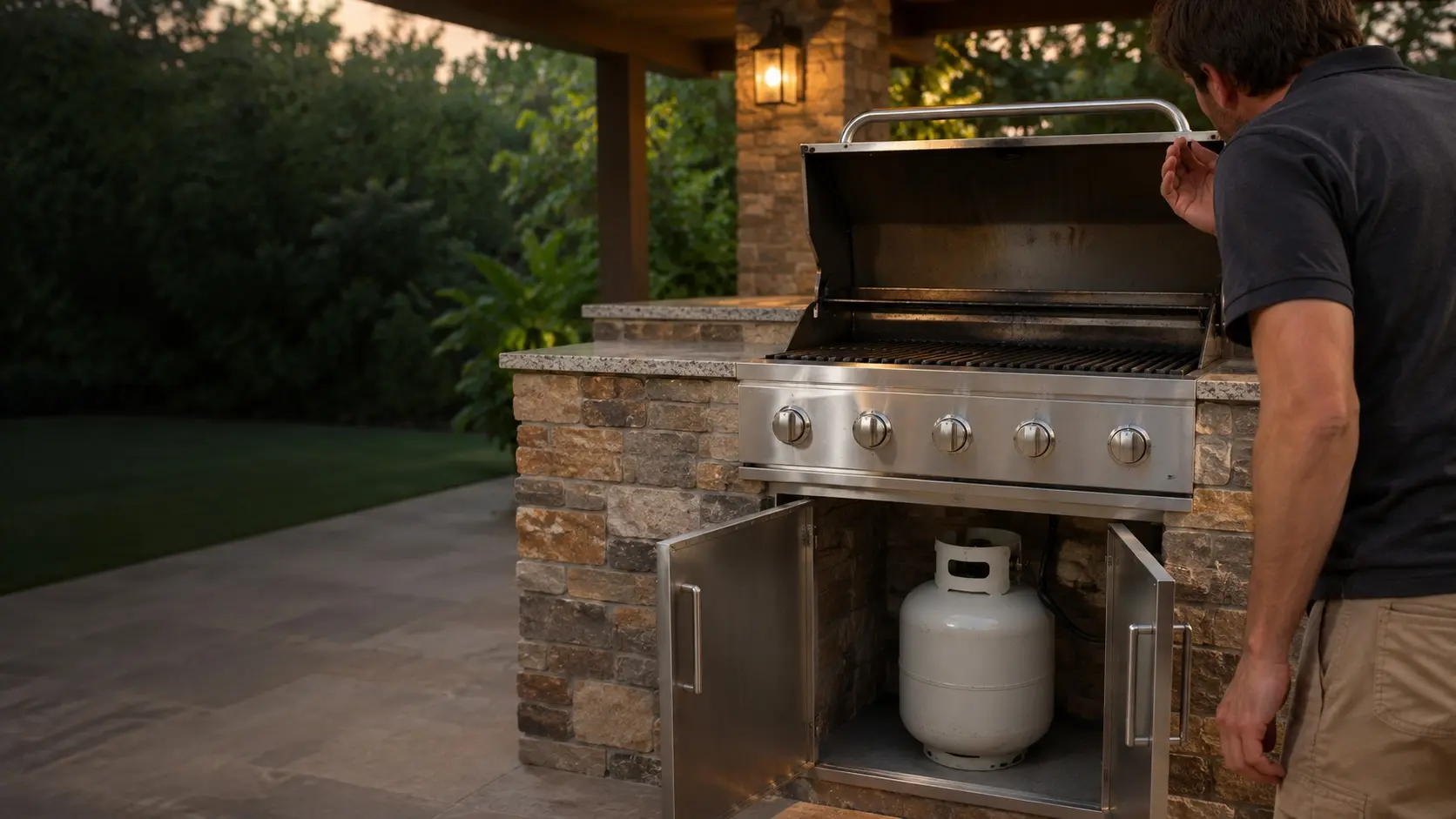
Turn every knob off, close the tank valve or the supply shutoff, raise the lid so any trapped gas can drift away, and step back. No lighter, no switch, no phone call beside the grill.
- Stay clear of flames, sparks and the igniter until the odor has gone.
- Wait the time your owner's manual gives before any relight (the manual for many models gives several minutes after a failed light); do not guess a shorter number.
- If the odor is still there after the gas is closed, leave the grill off and call your gas supplier or 911 from a distance.
The soapy-water check the makers describe
Makers and the Consumer Product Safety Commission describe a leak test on the hose and connections, for use when you reconnect the grill to its tank or after a gas smell, and only when the odor is faint and you are outdoors with no flame or spark near. With the burners off, brush a mix of liquid detergent and water over each connection with the tank valve open. Bubbles that appear mark a leak. If they do, turn the gas off and, if the connection can be tightened by hand, tighten it; if the bubbles continue, close the tank valve and take the grill to your gas dealer or a qualified repair person, such as a valve and regulator repair visit. Do not light the grill until a leak has been repaired. Do not use a flame to look for a leak, and do not take apart a regulator or valve. If the smell is strong, skip the test, stay clear and call your gas supplier or 911 from a distance.

How do I tell grease and food smells from a problem?
A rancid or stale-oil odor that rises when the grill heats is almost always fat that has built up out of sight. It collects on the drip tray, the catch pan, the underside of the lid and the firebox floor, and as it heats it releases that smell and, in time, becomes the fuel for a grease fire in the grill.
A cleaning order that clears most of it
- Cool the grill completely and close the gas.
- Empty and wash the grease tray and the catch pan, and do not line them with foil.
- Scrape the firebox floor and the underside of the lid; flaking carbon is not paint, and it will not hurt the finish.
- Brush the grates, then wash them in warm soapy water and dry them.
- Wipe the knobs and the control panel with a damp cloth, never a hose. A grill cleaning and safety inspection covers the parts you cannot reach.
Then run the grill hot with the lid closed for a short burn-off, for the time your manual gives, to clear what you could not reach. A faint smell of cooking during that burn-off is normal. Thick smoke from beneath the burners is not; it points to grease on the burners or bars, covered in heat shields, flavorizer bars and briquettes.
Source: NFPA — Grilling safety — remove grease and fat build-up from the grill and trays
When does a burning plastic smell mean a part is failing?
A plastic or rubber smell means something that should be cool is hot. On a cart grill the usual suspects are a hose or wire resting against the firebox, a knob beside a burner that is flaming up, a cover thrown on before the grill had cooled, or a side shelf part touching the hot lid.
Look before relighting. A hose that is discolored, soft, cracked or stiff needs replacing with the maker's part, and wiring with a melted jacket belongs to a repair visit. A smell that comes from behind the control panel can also be a nest or a flashback, so read flashback behind the knobs before you cook again.
Wind matters too. A grill that faces into the breeze can push heat back toward the knobs, and makers say to position it with its back to the wind, as covered in clearances around a grill.
Why does a grill smell musty after the winter?
On a freestanding gas grill, a closed, damp grill grows mildew the same way a closed shoe cupboard does. The smell comes from moisture trapped under a cover over a grill that was put away wet, or from grease that went rancid in storage.
- Wash the firebox, grates and lid interior with warm water and mild soap, and rinse.
- Leave the lid open for an afternoon in the sun before using it.
- Check the burners for webs and nests, because insects move in while a grill sits; the manual says to inspect before the first use of the season, and cleaning burners and venturi tubes shows how.
- Store the grill with a breathable, dry cover and not plastic sheeting.
Mildew itself is not a hazard to the gas system, though cooking over a dirty, moldy grate is no one's idea of a good time. Clean first, then burn off.


