Why burners and venturi tubes clog
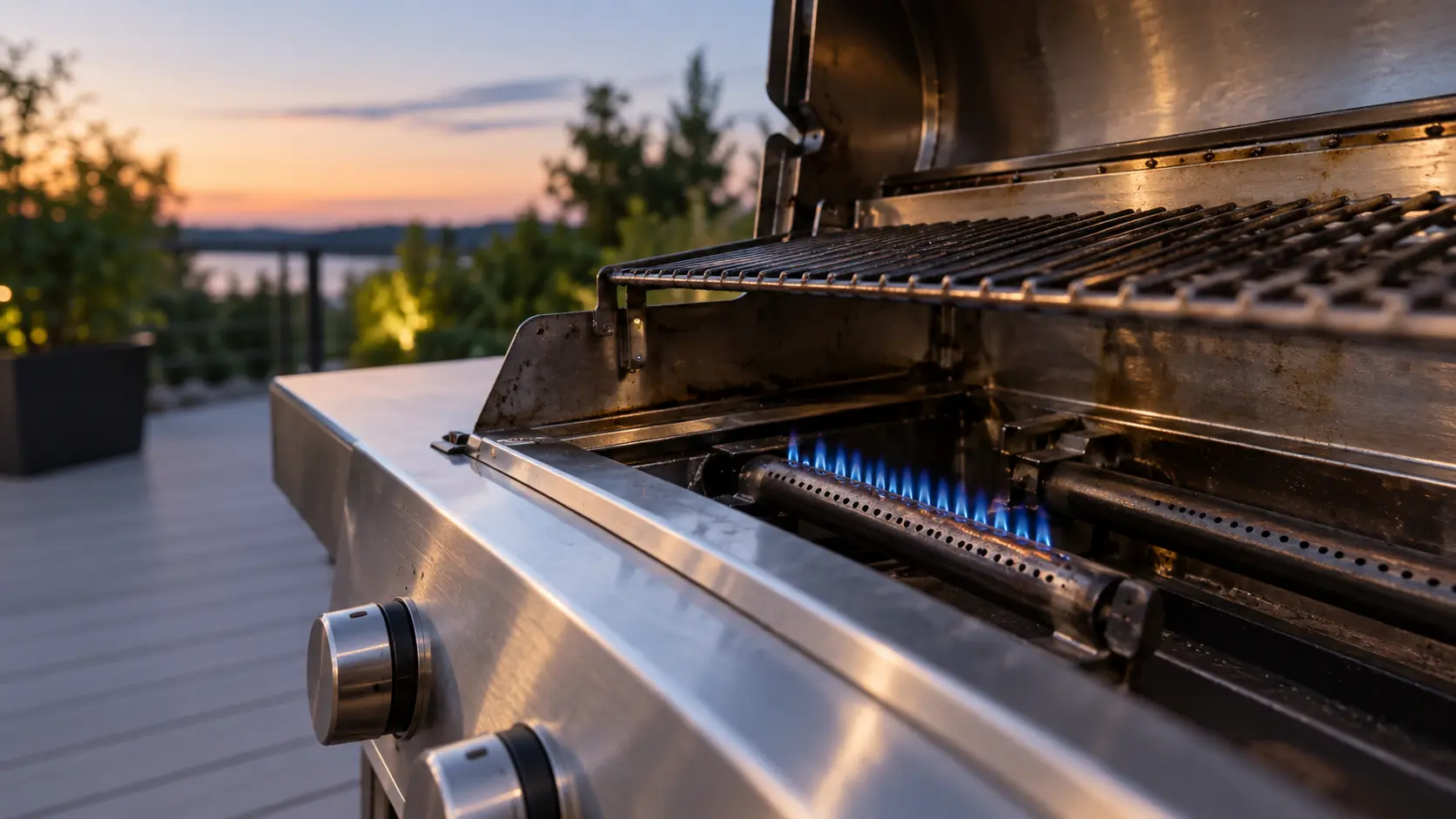
Each burner starts at the valve. A brass orifice sprays gas into the open end of the venturi, the tube draws air in through its shutter, and the mixture travels along the burner to the ports, where it burns. Scale and drippings narrow the ports from outside; webs, nests and debris block the tube from inside. Either one upsets the mixture of gas and air.
Lynx warns that spiders and insects nest in burners, venturis, valves and orifices, and that the blocked flow can cause a fire behind the control panel. That is why a grill left idle for a season should be checked before its first lighting, and why the CPSC asks for a venturi check at least once a year on every gas grill.
What flashback sounds and looks like
Blaze describes flashback as a whooshing, jet-like sound in or around the burner tubes, and asks owners to turn the burners off at once and clean them. If flame is visible at the front of a burner or under the knobs, it is no longer a cleaning job: close the gas at the cylinder or the shutoff, step back and let it burn out, then book a visit before the grill is lit again.
Source: Lynx — Professional grill care, use and installation manual — Spiders and insects nest in burners, venturis, valves and orifices and can cause a fire behind the control panel; clean with the grill cool, gas off and knobs off; burner removal steps; do not change the air shutter; wire brush, metal scraper, straightened paper clip, never a wooden toothpick; shake debris through the air shutter and inspect the inlet with a flashlight; burners centered on the orifice, level, without rocking.; CPSC — Gas grill safety fact sheet (Publication 467) — At least once a year check the venturi tube for insects, spiders or drippings; clear it with a pipe cleaner or wire, pushing blockages through toward the main part of the burner.
Before you lift anything
The first time you clean gas grill burners, plan on an hour for a three- or four-burner grill, most of it spent waiting and looking. Take a photo of the burners in place before you move one; it makes putting them back much easier.
- Set every knob to off and close the propane cylinder valve or the natural gas shutoff.
- Let the grill go completely cold; burners hold heat long after the lid feels cool.
- On a grill with lights or a rotisserie, disconnect the rotisserie and switch off the circuit, as Blaze asks.
- Lift out the cooking grates and whatever sits over the burners: flavorizer bars, flame tamers or briquette trays.
- Lay out a stainless bristle brush kept only for burners, a straightened paper clip, a pipe cleaner and a flashlight.
Source: Blaze — Professional grill instructional book — Flashback has a whooshing, jet-like sound: turn burners off and clean them with soap, water and a brush; inspect burners before each use; four symptoms of insect nests; disconnect the rotisserie and trip the breaker before cleaning; rear cotter pins hold each burner; rod or pipe cleaner inside the burner; burner end fitted correctly onto the valve; flame mostly blue, not lifting.

Lifting burners out, maker by maker
Each maker fastens its burners its own way, so the pages for your own model decide how yours come out. Three common arrangements show how much they vary.
Lynx brass burners
Lynx has owners lift each burner until its legs leave the frame, pull it toward the rear so the head slides off the brass orifice at the front, then tilt it sideways and lift it out. The maker asks that the air shutter setting not be disturbed while the burner is out.
Blaze cast stainless burners
Blaze holds each burner with a cotter pin at the bottom rear, reached from behind the grill head. With the pin out, the rod is pulled up and the burner slides back. On a head already set into an island, the pins are often removed at installation; if yours are still there and out of reach, stop and book rather than working blind behind the counter.
Weber tube burners and their spider screens
Weber's owner care for its Genesis II LX cleans the burners in place: the ports are brushed across with a clean stainless brush, taking care around the igniter electrode, and the spider and insect screens at the burner ends, under the control panel where they meet the valves, are cleaned with a soft brush. Taking the panel off to pull burners goes beyond that routine.
Clearing the ports and the venturi
With a burner in your hands, Lynx's method is straightforward: wire-brush the outside, scrape off stubborn scale with a metal scraper, and open any clogged port with a straightened paper clip, never a wooden toothpick, which can break and plug the hole. Shake loose debris out through the air shutter, then shine a flashlight into the inlet. A pipe cleaner or paper clip clears anything you can see. Blaze uses a rod or pipe cleaner for debris inside the burner.
The CPSC adds one useful direction: push a blockage through the tube toward the main body of the burner, not back toward the orifice. Weber, for its part, says never to push sharp objects into its port holes and never to reuse a brush that has cleaned the grates. The makers disagree on small details, so follow the manual for your own burner.
- Ports rusted together into long slots.
- Holes or cracks along the tube or at its seams.
- Metal that flakes away in layers under the brush.
- A venturi dented or bent where it meets the orifice.
When a burner is past cleaning
The list above marks a burner that no brushing will bring back. Put it back only if the grill has to be used before a new one arrives and the flame looks normal; otherwise leave that position unlit and order the part by the model number on the rating label.
Source: Lynx — Professional grill care, use and installation manual — Spiders and insects nest in burners, venturis, valves and orifices and can cause a fire behind the control panel; clean with the grill cool, gas off and knobs off; burner removal steps; do not change the air shutter; wire brush, metal scraper, straightened paper clip, never a wooden toothpick; shake debris through the air shutter and inspect the inlet with a flashlight; burners centered on the orifice, level, without rocking.; Blaze — Professional grill instructional book — Flashback has a whooshing, jet-like sound: turn burners off and clean them with soap, water and a brush; inspect burners before each use; four symptoms of insect nests; disconnect the rotisserie and trip the breaker before cleaning; rear cotter pins hold each burner; rod or pipe cleaner inside the burner; burner end fitted correctly onto the valve; flame mostly blue, not lifting.; Weber — Genesis II LX gas grill owner's manual — Brush across the burner ports with a clean stainless brush, avoiding the igniter electrode; clean the spider and insect screens at the burner ends under the control panel with a soft brush; never use a brush already used on the grates; never put sharp objects into the port holes; clean only when off and cool.; CPSC — Gas grill safety fact sheet (Publication 467) — At least once a year check the venturi tube for insects, spiders or drippings; clear it with a pipe cleaner or wire, pushing blockages through toward the main part of the burner.
Reseating each burner and the first lighting
This step matters more than the cleaning. Lynx insists that every burner go back centered on its brass orifice and resting level without rocking, and Blaze says the end of the burner must be fitted properly onto the gas valve so gas flows safely into it. If the mouth of the venturi misses the orifice, gas escapes into the firebox instead of mixing inside the tube.
Refit the shields and grates. With all knobs still at off, reopen the cylinder or the shutoff, then follow your manual's lighting steps while standing well back. Blaze describes a healthy flame as mostly blue, perhaps with a yellow tint, and not lifting off the burner. Flames that stay yellow from base to tip, a burner that pops, or fire showing at the air shutter all mean the same thing: knobs off, supply closed, visit booked.
Source: Lynx — Professional grill care, use and installation manual — Spiders and insects nest in burners, venturis, valves and orifices and can cause a fire behind the control panel; clean with the grill cool, gas off and knobs off; burner removal steps; do not change the air shutter; wire brush, metal scraper, straightened paper clip, never a wooden toothpick; shake debris through the air shutter and inspect the inlet with a flashlight; burners centered on the orifice, level, without rocking.; Blaze — Professional grill instructional book — Flashback has a whooshing, jet-like sound: turn burners off and clean them with soap, water and a brush; inspect burners before each use; four symptoms of insect nests; disconnect the rotisserie and trip the breaker before cleaning; rear cotter pins hold each burner; rod or pipe cleaner inside the burner; burner end fitted correctly onto the valve; flame mostly blue, not lifting.