
What makes a smoked turkey safe?
A smoked turkey is safe when every part of the bird has reached 165°F, and nothing about the smoke changes that. The USDA's figure for poultry is the same for roasting, grilling and smoking, and the only reliable way to know is a food thermometer.
Three habits do most of the work: a bird thawed in the refrigerator, a grill that holds steady indirect heat, and a probe in the right places. Cooking time is a guide, never the test; the thermometer is. The general chart is in safe temperatures for grilled food.
How do you thaw and prepare the bird?
Plan the thaw days ahead: a 16-pound bird needs about three to four days in the refrigerator, and a bird that is still icy in the middle on the morning of the cook cooks unevenly and stays in the danger zone longer. Here is the order that works:
- Move the frozen turkey to the refrigerator on its tray, bottom shelf, in the wrapper.
- Take out the giblets and neck once it has softened, and pat the bird dry.
- Keep it refrigerated until the grill is up to temperature, not on the counter while the grill warms.
Thaw a frozen turkey in the refrigerator, in a pan to catch drips, allowing roughly a day for every 4 to 5 pounds, or in cold water changed every 30 minutes. A turkey left on the counter spends its first hours in the danger zone.
Leave the stuffing out
Cook stuffing separately. Inside a grilled bird the center of the stuffing is slow to reach 165°F and the bird dries out waiting for it. If you brine, do it in the refrigerator, and rinse and dry the skin so it browns.
Keep raw and cooked apart
- Use one board and tray for the raw bird and another for the cooked
- Wash hands, the probe and tools after touching raw poultry
- Do not baste the finished bird with the same brush that touched the raw one

How do you hold steady indirect heat?
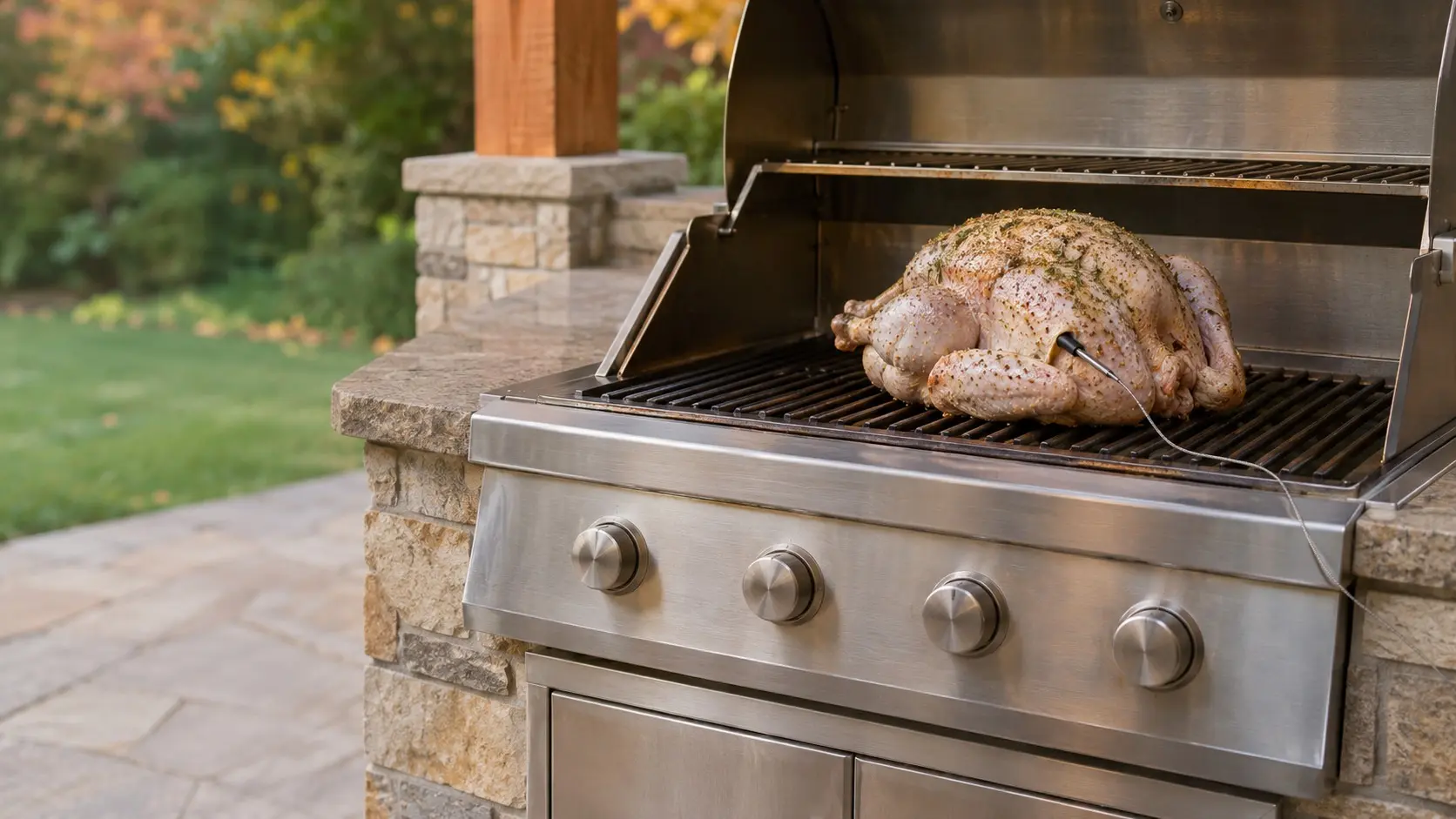
Smoke chips or a smoker box add flavor on a gas grill but never extra safety, so judge the bird by temperature, not by color. Cook the turkey with the heat beside it, not under it, and keep the cooking chamber steady at 225°F to 300°F, the range USDA FSIS gives for smoking meat and poultry. FSIS also advises two thermometers, one in the food and one for the chamber. On a gas grill that means lighting the outer burners and setting the bird over the cool middle. On a pellet grill it means setting the controller and leaving the lid shut.
On a gas grill
Put the bird in a roasting pan or on a rack over the unlit burners, with a pan of water or drippings to catch fat. Run the grill empty for 15 minutes first to confirm each burner lights and the chamber settles; if it does not, see why a grill will not light before the bird goes on. Check the tank before you start, because a tank that runs out at hour three is how a turkey ends in the danger zone. The cold-weather case is in grill in cold weather.
On a pellet grill
Many owners meet this on a pellet and hybrid grill, which holds the temperature by controller instead of by knob. A pellet grill makes its own smoke at a set temperature, so the risk is a controller that cannot hold it or a hopper that runs out. Fill the hopper for the whole cook. If the temperature swings or the grill stops feeding, see caring for a pellet grill for the first checks.
Source: USDA FSIS — Smoking meat and poultry — keep the smoker at 225°F to 300°F; thaw fully first
Where and how do you check 165°F?
Check 165°F in the innermost part of the thigh, the innermost part of the wing and the thickest part of the breast, without touching bone. All three should read at least 165°F; the thigh is usually the slowest.
| Place to probe | What you want | Notes |
|---|---|---|
| Innermost thigh | 165°F | Near the bone, not touching it |
| Innermost wing | 165°F | Often reads first |
| Thickest breast | 165°F | Check the middle, not the edge |
| Grill chamber | Steady, 225°F to 300°F | Read it near the grate; a lid dial can differ |
If one spot is under 165°F, close the lid and check again in 15 minutes. Do not pull the bird because the skin looks done or the juices run clear; neither proves safety. Smoke can also leave a pink ring in properly cooked meat, so color is no guide in either direction.
A few habits make the probe more reliable:
- Check the thermometer in ice water first; it should read 32°F
- Probe in at least three places, and re-probe after any move
- Let the bird rest about 20 minutes covered loosely; it stays hot and carves better
- Never reuse the probe on the cooked bird without washing it
Source: USDA FSIS — Safe minimum internal temperature chart — 165°F for poultry
How long can the turkey sit, and what if the grill cannot hold temperature?
Cooked turkey should spend no more than 2 hours between 40°F and 140°F, and no more than 1 hour if it is above 90°F outside. Carve it, split it into shallow containers and refrigerate leftovers inside that window.
The harder problem is during the cook. A grill that sits at 175°F for three hours, or a bird that drifts for long periods, is a food-safety problem, not only a slow dinner. If the temperature will not rise, move the turkey to a preheated oven, finish it there to 165°F and have the grill looked at afterward. A diagnostic visit finds why a gas grill runs cold; a pellet grill auger and controller repair covers a grill that will not feed or hold its setting.
Source: USDA FSIS — Danger zone, 40°F to 140°F — the 2-hour and 1-hour limits


