
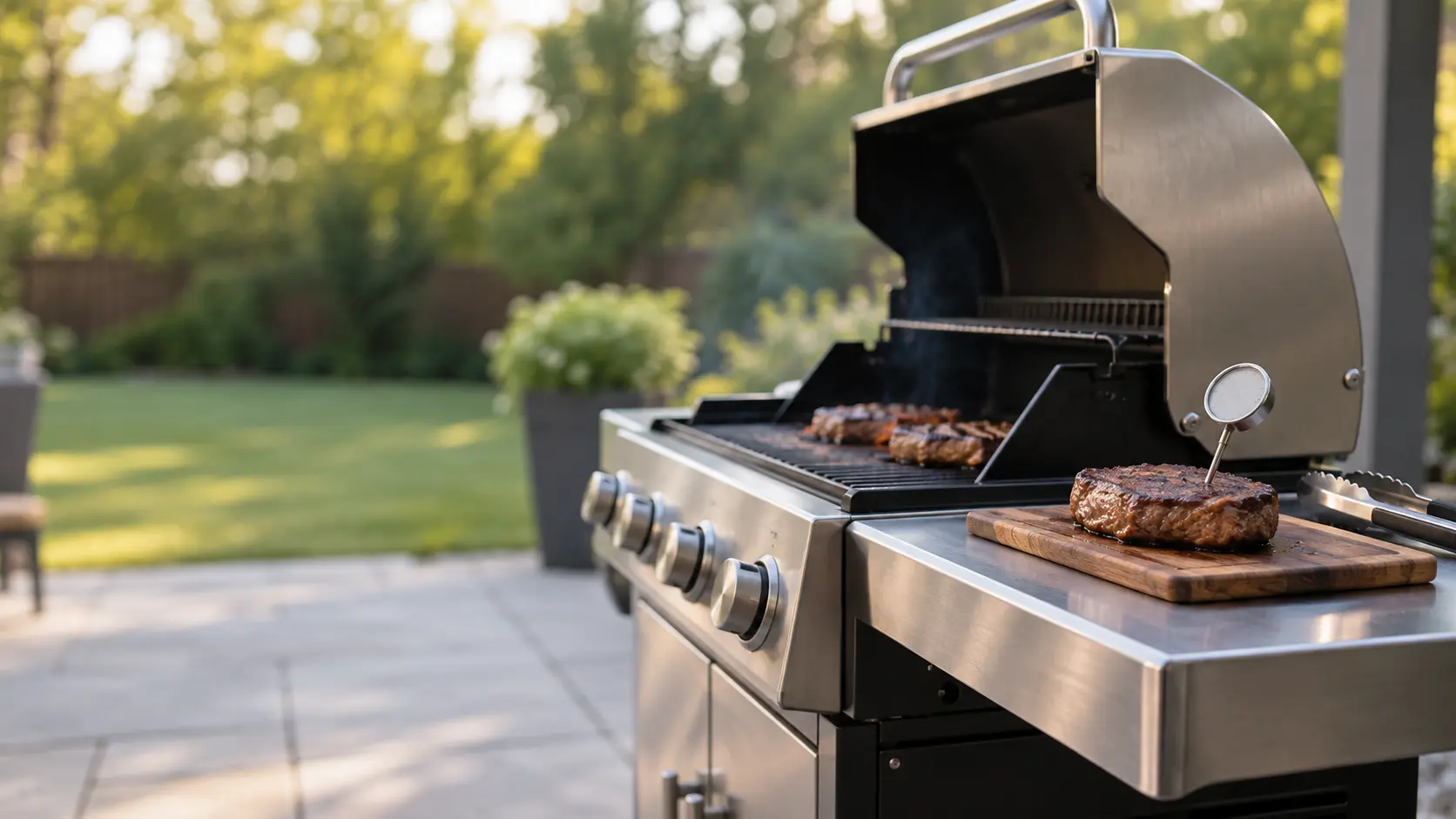

Flare-up or grease fire in a grill: telling them apart
Fat dripping from a burger onto a hot flavorizer bar lights with a short burst of yellow flame, and that burst is over as soon as the drop has burned. Moving the food to a cooler part of the grate is all it needs. A grease fire in a grill looks different: flame keeps rising from under the grates after the meat is off, smoke rolls thick and dark out of the lid gap, and orange light shows below the firebox where the tray slides in.
The fuel is the reason it does not stop. Every cook leaves a little fat on the heat shields, on the sloped firebox floor and in the slide-out tray, and a season of that is a shallow pan of fuel sitting right under the burners. Once it is hot enough to light, turning the food or closing the lid for a moment does nothing, because the fire is not on the grate at all.
Signs it has gone past a flare-up
- Flames keep climbing with the grates empty.
- Fire or glow shows at the front or bottom of the firebox, around the grease tray.
- Smoke pours from the lid seams in a steady stream rather than a puff.
- The lid thermometer climbs past anything you set the burners for.
- Knobs, the control panel or the cart side feel hot from a step away.
Taking away the gas and the air, in that order
The maker's order is short. Weber's owner's manual says that if a grease fire occurs, turn off all burners and leave the lid closed until the fire is out. The knobs come first so the burners stop adding heat, then the gas is closed at the source: the handwheel on top of the propane tank, turned clockwise, or the shutoff valve on a natural gas line. That leaves the fat as the only fuel, and a closed lid limits the air it can burn with.
Only do the parts you can do without putting a hand or face near flame. If fire is licking out of the front of the grill over the knobs, or the tank sits in a cabinet full of smoke, skip the knobs and the valve and step away; the fire department can shut the gas off from a distance you cannot safely reach.
Lowering the lid, only if it is safe
Close the lid by its handle with a long mitt on, standing to the side rather than over the grill, and only when the flame is inside the firebox. Do not lift it again to check. A lid opened on a smoldering firebox lets in a rush of air, and the flame can jump back up at the person holding the handle. Leave it closed until the glow has gone and the grill is cold to the touch.
Why water, flour and a spray bottle stay away
Blaze's use and care guide is plain about water on a grease fire: do not use it, because a violent steam explosion may result, and the fire should be smothered with a multipurpose ABC extinguisher instead. Lynx gives the same rule and asks for an ABC extinguisher to be accessible at all times. Water sinks under the hot fat, flashes into steam and flings burning grease out of the firebox onto the deck, the cart and anyone standing close.
Source: Weber — Spirit natural gas grill owner's manual (8653810, US) — Should a grease fire occur, turn off all burners and leave the lid closed until the fire is out; check the grease tray and catch pan before each use and remove excess grease; do not line the tray or cookbox with foil

When the grill fire becomes a 911 call
Call 911 as soon as flame leaves the grill: fire at the cover or the cart shelf, at a deck board or a railing, in shrubs, or anywhere on the house. Call too if the fire inside the firebox keeps growing after the gas is closed, or if flame reaches the propane tank, and tell the dispatcher a cylinder is involved. Move everyone well away from the grill first and make the call from a safe distance.
NFPA's advice for any cooking fire applies on the patio as well: if you do try to fight it, make sure others are getting out and keep an open path away from the grill at your back. An ABC extinguisher aimed at the base of the flame through the lid gap is a reasonable try on a small fire; a fire that is already on the siding is not yours to fight.
Source: NFPA — Cooking safety — If you try to fight a cooking fire, make sure others are getting out and you have a clear way out; call 9-1-1
After the fire is out and the grill is cold
Leave the tank valve closed and the knobs off until the grill has been looked over. A fire hot enough to burn a full tray can soften plastic knobs, cook the insulation on igniter wires, harden the gas hose where it passes near the tray and warp thin heat shields. None of that is always visible, and a hose damaged by heat is exactly the kind of part that leaks the next time the tank is opened.
What the owner can do is look without tools and clean what the manual already assigns to the owner. Photograph the knobs, the hose along its full run and the underside of the firebox, empty the cold tray, and scrape the cold firebox floor into the tray with a plastic scraper.
- Knobs that are melted, blistered or loose on their stems
- A hose that is stiff, cracked, blistered or blackened
- Igniter wires with bubbled or bare insulation
- Heat shields, flavorizer bars or briquettes that are cracked, sagging or caked
- Scorched paint or melted panels on the cart below the firebox
Keeping fat from piling up under the burners
Almost every grease fire starts in a place the owner can reach with a scraper once the grill is cold. Weber tells owners to check the slide-out grease tray and catch pan for build-up before each use and to remove excess grease to avoid a grease fire, and never to line the tray or the cookbox with aluminum foil. Lynx asks for the drip pan to be pushed all the way to the back whenever the grill is used and warns that foil changes the airflow and traps heat around the controls, enough to melt knobs and ignition parts.
NFPA's grilling guidance puts removing grease or fat build-up from the grill and the trays below it near the top of its list, and its research found that the grill had not been cleaned in roughly one-fifth of the grill fires it studied. The USFA flyer asks for a clean after each use for the same reason.
Habits at the grill itself
- Look at the tray and catch pan before lighting, not after the meal.
- Scrape the firebox floor toward the tray once the grill is cold.
- Trim thick fat caps and do not over-oil food before it goes on.
- Leave one burner low or off so fatty food can be moved off direct flame.
- Never walk away from a lid-down preheat or a lid-down cook on high.
Source: Weber — Spirit natural gas grill owner's manual (8653810, US) — Should a grease fire occur, turn off all burners and leave the lid closed until the fire is out; check the grease tray and catch pan before each use and remove excess grease; do not line the tray or cookbox with foil; Lynx — Professional Grill Care, Use and Installation Manual — Keep an ABC extinguisher accessible and never use water or other liquids on a grease fire; never grill without the drip pan pushed fully back; foil traps heat and can melt knobs and ignition modules; NFPA — Grilling safety — Remove grease or fat build-up from the grill and the trays below it; the grill had not been cleaned in roughly one-fifth of grill fires; USFA — Grilling fire safety flyer — Clean the grill after each use to remove grease that can start a fire


