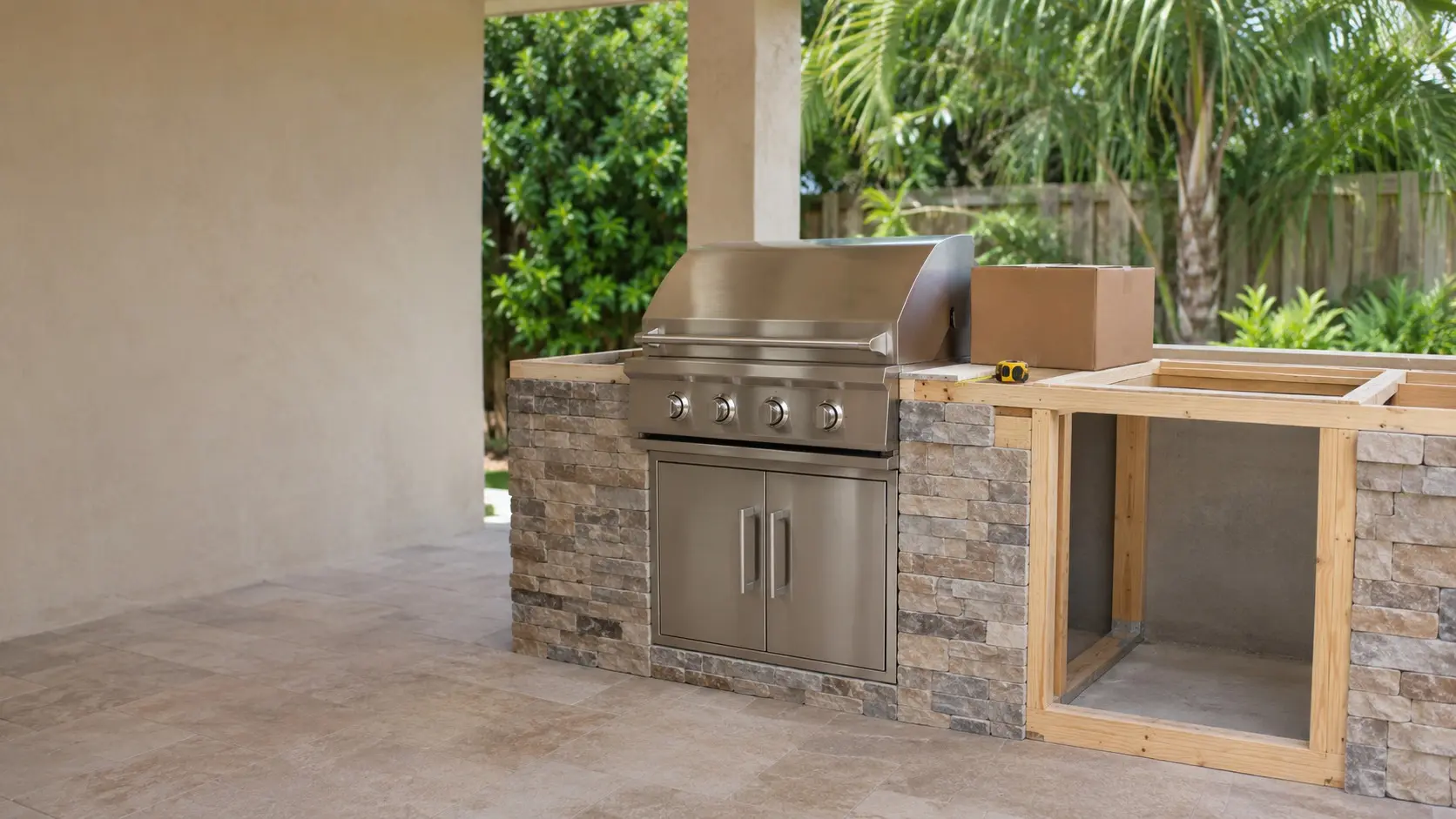


What is an insulated grill jacket?
An insulated grill jacket is a metal liner, often double-walled, that fits in the island cutout and surrounds the body of a built-in grill. It keeps the grill's heat from reaching wood framing, plywood or other combustible material. Many makers sell it as an accessory and call for it by name in the installation instructions.
Why a built-in is different from a cart grill
A cart grill stands on its own with open air around it. A built-in sits inside a box of framing, where the sides and bottom of the firebox are only inches from whatever the island is made of. The same heat that is harmless in open air can scorch or ignite the wrong material in a closed space. The guide on built-in or cart grill compares the two for owners deciding which to buy.
What the jacket is not
A jacket is not a fireproof island by itself and it does not replace clearance to overhead items. It is one part of an installation the maker has tested for a specific model. Substituting a different liner or leaving it out can leave the installation outside what the grill was designed for.
When does a built-in grill need a jacket?
The maker's instructions decide, and the usual dividing line is what the island is made of. If the framing is wood, wood sheathing or another combustible material, a jacket is typically required. If the island is built entirely of non-combustible material, such as masonry or steel studs with cement board, the instructions may allow it without.
Table: Island construction and the jacket question
| Island construction | What the instructions usually say |
|---|---|
| Wood studs or plywood | A jacket is typically required |
| Steel studs with cement board | Check the cutout sheet; often allowed without, with listed clearances |
| Masonry or poured concrete | Often no jacket, but follow the stated clearances |
| Mixed materials | Treat the combustible part as governing |
Read the instruction sheet first
The cutout and installation sheet lists the cutout size, the clearances to the sides, back and overhead, the vent openings and whether a jacket is required for each island type. Check it before the framing is built, because the cutout is larger with a jacket than without. If the sheet is lost, the model number on the rating label locates it; see find the grill rating label.
Do not guess from a friend's island
Another grill with a different design or burner layout may have different requirements. A model that does not need a jacket tells you nothing about yours.

How is a jacket sized and fitted?
A jacket is made for a specific grill or a family of grills, so size it to the model and not to the opening you already built. The air gap between the double walls and the gaps around it are part of how it works.
What to match
- The grill's model number against the jacket's compatibility list.
- The cutout width, depth and height shown on the maker's sheet.
- The vent openings the island needs for airflow, especially for propane, which sinks.
- The access for the gas line, any electrical feed and the shutoff.
Fitting steps for the builder
- Build the framing to the dimensions on the sheet, plus any allowance for the jacket.
- Set the jacket into the cutout and check that it is level and square.
- Keep combustible material away from the jacket's flanges as the sheet specifies.
- Leave the gas line, the shutoff, the connection to the grill and the leak test to a qualified installer or the gas utility, in the order the sheet gives.
A jacket that is a little too small will not allow the grill to seat, and a jacket that is loose will rattle or leave gaps. Neither is the right fix for an out-of-square cutout; rebuild the opening instead.
What about venting, gas and clearances?
A jacketed island still needs ventilation, a safe gas connection and clearance to nearby structures. Propane is heavier than air, so an enclosed cabinet with no vents can trap it; natural gas rises. The maker's sheet and local code spell out the vents.
Gas and electrical work
The gas supply, shutoff and leak test must be done by a qualified installer or the gas utility. Any wiring for lights, an igniter or a rotisserie belongs to an electrician. A jacket does not change that, and a gas smell is a reason to leave the area and call the utility. Read clearances around a grill for the distances to walls, railings and roofs.
Inspection after the build
After the install, ask for a safety check. A grill cleaning and safety inspection looks at the gas train, connections and burner condition, and a diagnostic visit can check a built-in that will not light once it is in its island. If the grill later shows a gas smell, see grill gas smell and stop using it.
What can go wrong without a jacket?
Heat can scorch or char framing over time, and sometimes ignite it. The damage can build for years before it is visible, which is why, where the maker calls for a jacket, it is part of the installation and not an optional upgrade.
Signs to watch for
- Discolored or blackened wood near the grill body.
- A burning smell after the grill has cooled.
- Warped or bubbled finishes on the island's face.
- Smoke from the island's seams or the gap around the grill.
If you see any of these, stop using the grill, let it cool and have it inspected. The ones that appear after the island is built are the hardest to fix. If you inherited an island and do not know whether a jacket is behind the grill, look at the side gap with the grill off and cold, check the model's instruction sheet and ask an installer before cooking.


