

Who decides whether a grill on a balcony is allowed
Three sets of rules stack on top of each other. The local fire code sets the floor for everyone in the jurisdiction, and codes differ from one city or county to the next. The building's own rules, in a lease, a condominium declaration or an association's bylaws, can be stricter than the code but never looser. The grill's manual adds what the maker requires wherever it is used. A grill on a balcony has to satisfy all three.
The quickest way to an answer is the local fire department's or fire marshal's page on grills, followed by the lease or the association rules. If neither says anything, call the fire department's non-emergency line or the property manager before carrying a tank upstairs.
- The local fire department's or fire marshal's page on grills
- The lease, condominium declaration or association rules
- The grill's manual, for clearances and where it may be used
- The property manager, for where a tank may be kept
Why balconies worry fire officials
The numbers explain the caution. NFPA's research found that nearly one-quarter of grill structure fires started on an exterior balcony or open porch. An older USFA report on grill fires at homes came to a similar share, 24 percent starting on exterior balconies and unenclosed porches, and found propane to be the power source in 69 percent of grill fires on residential properties. A fire on a balcony has the wall, the soffit and the unit above within a few feet.
Source: Chesapeake, VA Fire Department — Grilling Safety — Open-flame cooking devices not on combustible balconies or within 10 feet of combustible construction, except one- and two-family dwellings, sprinklered buildings and 1-pound propane cylinders; most retail grills use 5-pound or larger containers; NFPA 58 limits larger cylinders on balconies above the first floor; electric grills allowed; removed tanks not stored on the balcony or in the unit; lease rules may be stricter
One fire code, read as an example
The Chesapeake, Virginia, Fire Department publishes the rule it enforces under the Statewide Fire Prevention Code, and it is a common wording. Charcoal burners and other open-flame cooking devices may not be operated on combustible balconies or within 10 feet of combustible construction. The exceptions are one- and two-family dwellings, buildings whose balconies and decks are protected by an automatic sprinkler system, and propane cooking devices whose cylinders hold no more than a nominal 1 pound of gas.
The same page explains what that means in practice. Most gas grills sold at big retailers use cylinders of 5 pounds or more, which are not allowed at apartment and condominium communities under the rule, while an electric grill or a grill running on a small camping-size cylinder is. It also cites NFPA 58, which keeps cylinders larger than about 1 pound of propane off the decks and balconies of buildings with two or more units above the first floor unless those units are served by exterior stairways.
- A detached house or duplex is usually outside the balcony rule, though the manual's clearances still apply.
- Apartments and condominiums are where the limits bite hardest.
- Sprinkler protection that covers the balcony itself can change the answer.
- Tank storage has its own rules: Chesapeake says a removed tank may not be kept on the balcony or inside the unit.
Your city may word it differently
Codes are adopted and amended locally, so treat the Chesapeake page as a picture of how these rules usually read, not as the rule where you live. Some jurisdictions add limits for rooftop terraces, some for wood decks on multifamily buildings, and associations often ban grills on balconies outright.
Source: Chesapeake, VA Fire Department — Grilling Safety — Open-flame cooking devices not on combustible balconies or within 10 feet of combustible construction, except one- and two-family dwellings, sprinklered buildings and 1-pound propane cylinders; most retail grills use 5-pound or larger containers; NFPA 58 limits larger cylinders on balconies above the first floor; electric grills allowed; removed tanks not stored on the balcony or in the unit; lease rules may be stricter

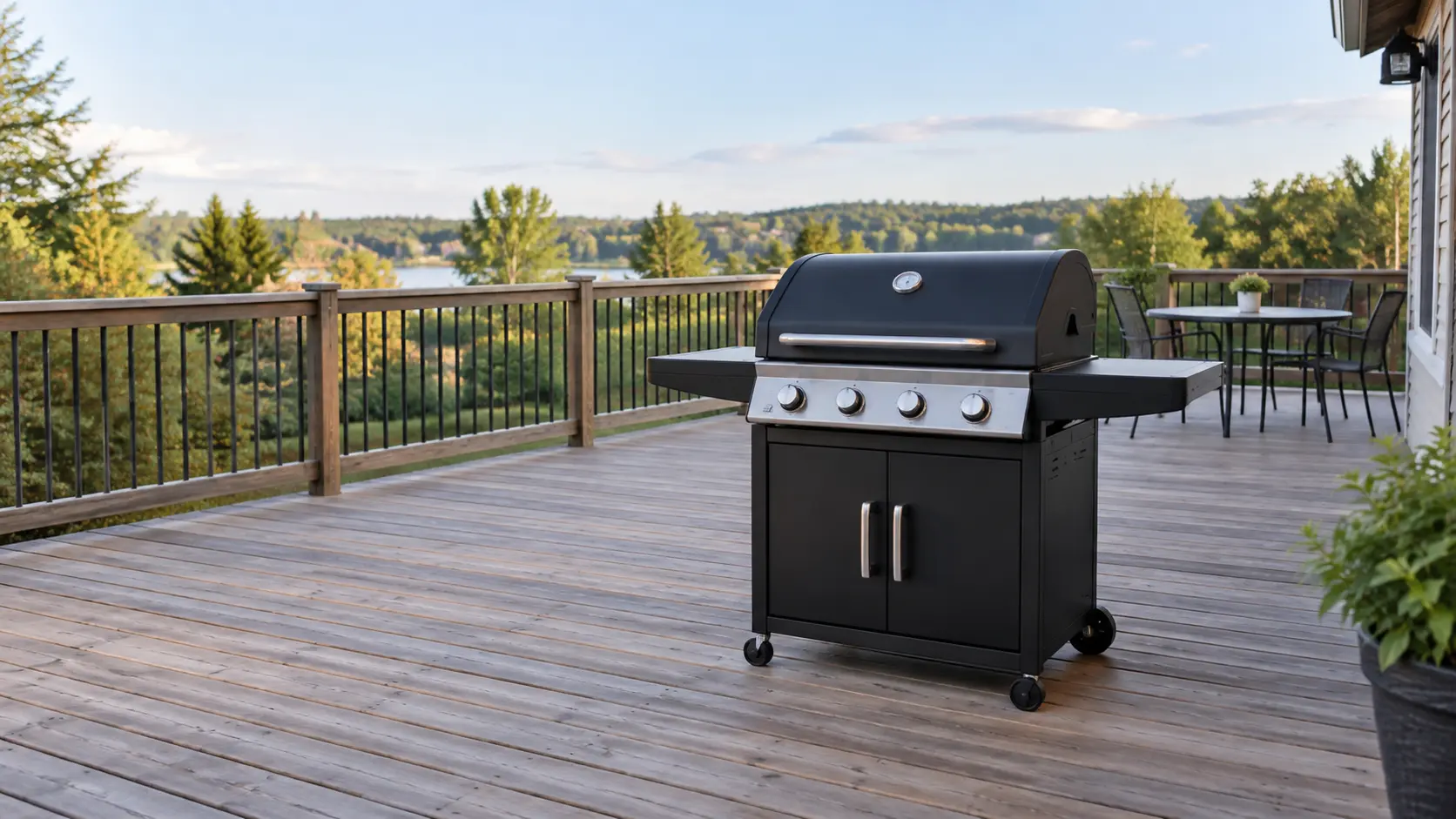
A grill on a house deck
At a single-family house the code usually leaves the deck to the owner, and the maker's manual becomes the rule to follow. Weber's US manual keeps its cart grills 24 inches from combustible materials and out from beneath overhead combustible construction, and the USFA flyer asks for at least 3 feet from siding, deck rails and eaves. NFPA adds overhanging branches and a 3-foot zone that children and pets stay out of.
A wooden deck is itself combustible, which makes housekeeping part of safety. Lynx tells owners never to grill without the drip pan in place and pushed all the way back, because hot grease can run down and ignite. Blaze asks for a firm, level surface under the grill, which on a deck means a spot where the boards are sound and the cart does not rock.
Covered decks, screened porches and pergolas
CPSC's fact sheet says not to use a grill in a garage, breezeway, carport or porch, or under a surface that will burn. Blaze notes that balconies and pergolas are partly enclosed spaces where it can be hard to say whether they count as indoors, and asks owners to consult the authority having jurisdiction when unsure. A screened porch fails the test in Weber's manual, since screened openings do not count as permanently open.
Source: NFPA — Grilling safety — Nearly one-quarter of grill structure fires started on an exterior balcony or open porch; place grills away from the home, deck railings, eaves and branches; keep children and pets three feet away; USFA — Grilling fire safety flyer — Keep the grill at least 3 feet from siding, deck rails and eaves; Weber — Spirit natural gas grill owner's manual (8653810, US) — Not within 24 inches of combustible materials or beneath overhead combustible construction; screened openings are not permanent openings; Blaze — Professional Series Use and Care Guide — Use on a firm level surface; balconies and pergolas are partial enclosures, consult the authority having jurisdiction; Lynx — Professional Grill Care, Use and Installation Manual — Never grill without the drip pan pushed fully back; keep electrical cords away from walkways; if stored indoors, detach the cylinder and leave it outdoors
Pellet, electric and built-in grills in tight spaces
A pellet grill burns wood inside a firepot, so a fire code that restricts open-flame cooking devices may cover it just as it covers gas and charcoal; check the local wording rather than assuming it is exempt. It also needs a grounded outdoor outlet within reach of its cord, and Lynx's advice to keep electrical cords away from walkways applies to a narrow balcony more than anywhere.
Electric grills are the option the Chesapeake page names for apartment balconies. A built-in grill head on a rooftop terrace or a high-rise balcony is a building project rather than a purchase: its installer works from the maker's installation manual and the local authority's approval, and the building's rules come first.
Source: Chesapeake, VA Fire Department — Grilling Safety — Open-flame cooking devices not on combustible balconies or within 10 feet of combustible construction, except one- and two-family dwellings, sprinklered buildings and 1-pound propane cylinders; most retail grills use 5-pound or larger containers; NFPA 58 limits larger cylinders on balconies above the first floor; electric grills allowed; removed tanks not stored on the balcony or in the unit; lease rules may be stricter; Lynx — Professional Grill Care, Use and Installation Manual — Never grill without the drip pan pushed fully back; keep electrical cords away from walkways; if stored indoors, detach the cylinder and leave it outdoors
Propane tanks off the balcony and out of the home
The cylinder is often what a balcony rule is really about. CPSC says never to use or store a propane container indoors and never to keep a spare near or under the grill. Lynx asks that if a grill is stored indoors, its cylinder be detached and left outdoors in a well-ventilated area away from heat. In a building with no permitted outdoor spot for a tank, that alone can settle the question.
Source: CPSC — Safety Checks for the Grill (fact sheet, Publication 467) — Do not use a grill in a garage, breezeway, carport, porch or under a surface that will burn; never store a spare container under or near the grill; never use or store a propane container indoors; Lynx — Professional Grill Care, Use and Installation Manual — Never grill without the drip pan pushed fully back; keep electrical cords away from walkways; if stored indoors, detach the cylinder and leave it outdoors


