

What the safety device is and why it trips
When the cylinder valve opens, gas rushes into an empty hose. If the burner valves are shut, the pressure builds in a second and the device settles into its normal position. If a burner knob is already open, gas keeps flowing out the far end, the pressure never builds, and the device reads that as a broken hose. Weber explains that it then reduces the flow from the tank to about 10% or less of normal, which Weber calls bypass.
Napoleon lists the triggers in its troubleshooting table: an improper lighting sequence, and a cylinder valve opened too quickly. Lynx adds that improper lighting procedures can activate the cylinder's flow-control device. Weber also notes that cold weather slows the pressure build-up, so a winter tank needs longer before a knob is turned.
- A burner or side burner knob left on while the tank was opened.
- The cylinder valve spun open in one fast turn.
- A new tank connected while a knob was still turned.
- A cold evening with the knob turned the moment the valve opened.
How a grill in bypass behaves
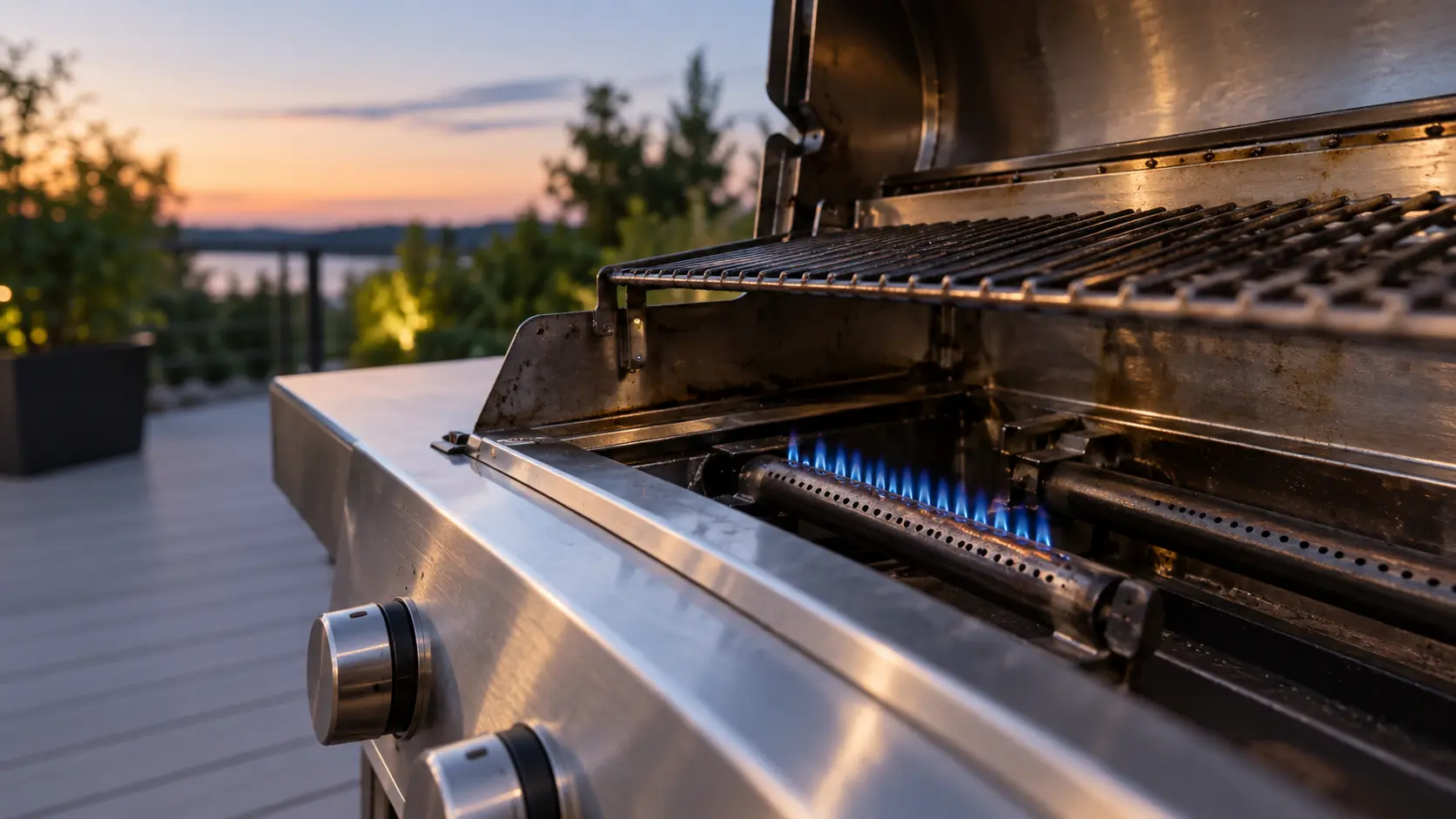
The burners light, but the flames are small and blue even on high, and they sag further when a second burner is turned on. The hood creeps to a few hundred degrees and stops. On some grills a burner will not light at all. Because the flow is cut at the tank, every burner, including a side burner on the same hose, suffers at once.
Source: Weber — Why won't your gas grill get hot? Bypass mode — The safety device reduces flow to about 10% or less; leak test first; lid open and all knobs off including the side burner, open the tank and wait several seconds; cold weather delays pressure; 500 to 550°F in 10 to 15 minutes; Lynx — Care & Use / Installation manual — Improper lighting can activate the cylinder's flow control; reset: burners off, close the valve, wait 30 seconds, reopen very slowly, wait a few seconds; use the supplied hose and regulator; almost-empty cylinders lack pressure; regulator must not touch the grill; Napoleon — Built-In Series owner's manual — Low flow from improper lighting or a valve opened too quickly; regulator low-flow reset: burners off, close the tank, wait 5 minutes, reopen slowly, a few seconds to equalize; humming regulator on hot days is normal; pinched hose
Rule out a real leak before the reset
The device exists to catch leaks, so Weber's first step for a grill that seems to be in bypass is a leak test. Use the soapy water method your manual describes, on the connections it names, with every flame far away; NFPA's tip sheet describes the same test on the tank hose.
If you smell gas, or bubbles grow at any joint, do not reset anything. Close the cylinder valve, leave the knobs off and the lid open, and book a visit; if the smell stays after the valve is closed, move away and call the gas utility or 911. A regulator or hose that leaks is replaced as an assembly, and Lynx asks that the one supplied for the grill be used.
A humming regulator is not a leak
Napoleon notes that a regulator can hum on hot days from internal vibration, and that this does not affect performance or safety. A hum with a normal flame is left alone; a hiss with a smell is not.
Source: Weber — Why won't your gas grill get hot? Bypass mode — The safety device reduces flow to about 10% or less; leak test first; lid open and all knobs off including the side burner, open the tank and wait several seconds; cold weather delays pressure; 500 to 550°F in 10 to 15 minutes; Lynx — Care & Use / Installation manual — Improper lighting can activate the cylinder's flow control; reset: burners off, close the valve, wait 30 seconds, reopen very slowly, wait a few seconds; use the supplied hose and regulator; almost-empty cylinders lack pressure; regulator must not touch the grill; NFPA — Grilling safety tip sheet — Soap and water solution on the tank hose; bubbles mean a leak

The reset, and how makers differ on the wait
The idea is identical across makers: everything closed, a pause, then gas let back in gently with the burner valves shut so pressure can build. Weber's version asks for the lid open and every knob off, including the side burner, then the tank opened and several seconds of waiting before a knob is touched. Lynx closes the cylinder valve, waits 30 seconds, then reopens it very slowly and waits a few seconds before relighting a burner.
Napoleon is the most patient: burners off, tank valve closed, five minutes, then the valve fully reopened slowly and a few seconds for the pressure to equalize. If your manual gives a wait, use it; if it does not, the longer wait costs nothing.
Proving it worked
Light the main burners as the manual shows, set them to high and close the hood. Weber expects its gas grills to reach roughly 500 to 550°F within 10 to 15 minutes. If yours climbs normally, the reset worked, and lighting in the right order every time keeps it from happening again.
Source: Weber — Why won't your gas grill get hot? Bypass mode — The safety device reduces flow to about 10% or less; leak test first; lid open and all knobs off including the side burner, open the tank and wait several seconds; cold weather delays pressure; 500 to 550°F in 10 to 15 minutes; Lynx — Care & Use / Installation manual — Improper lighting can activate the cylinder's flow control; reset: burners off, close the valve, wait 30 seconds, reopen very slowly, wait a few seconds; use the supplied hose and regulator; almost-empty cylinders lack pressure; regulator must not touch the grill; Napoleon — Built-In Series owner's manual — Low flow from improper lighting or a valve opened too quickly; regulator low-flow reset: burners off, close the tank, wait 5 minutes, reopen slowly, a few seconds to equalize; humming regulator on hot days is normal; pinched hose
When a reset changes nothing
A reset clears a tripped device and nothing else. If the flames are still small, Lynx points to an almost-empty cylinder, which may not have enough pressure to run the burners on high; Napoleon adds a pinched supply hose. Check both. A hose kinked behind the cart, a regulator dented by a fall, or frost on the regulator on a warm day are all reasons to stop and book.
If one burner stays weak while the others recover, the regulator was never the problem; that burner's tube or ports are, and the guide on low and yellow flames picks up from there. Natural gas grills have no bypass, so a weak natural gas flame points to the supply pipe, its pressure or the orifices.
- Tank weight checked and the cylinder not nearly empty.
- Hose free of kinks, cracks and hot surfaces.
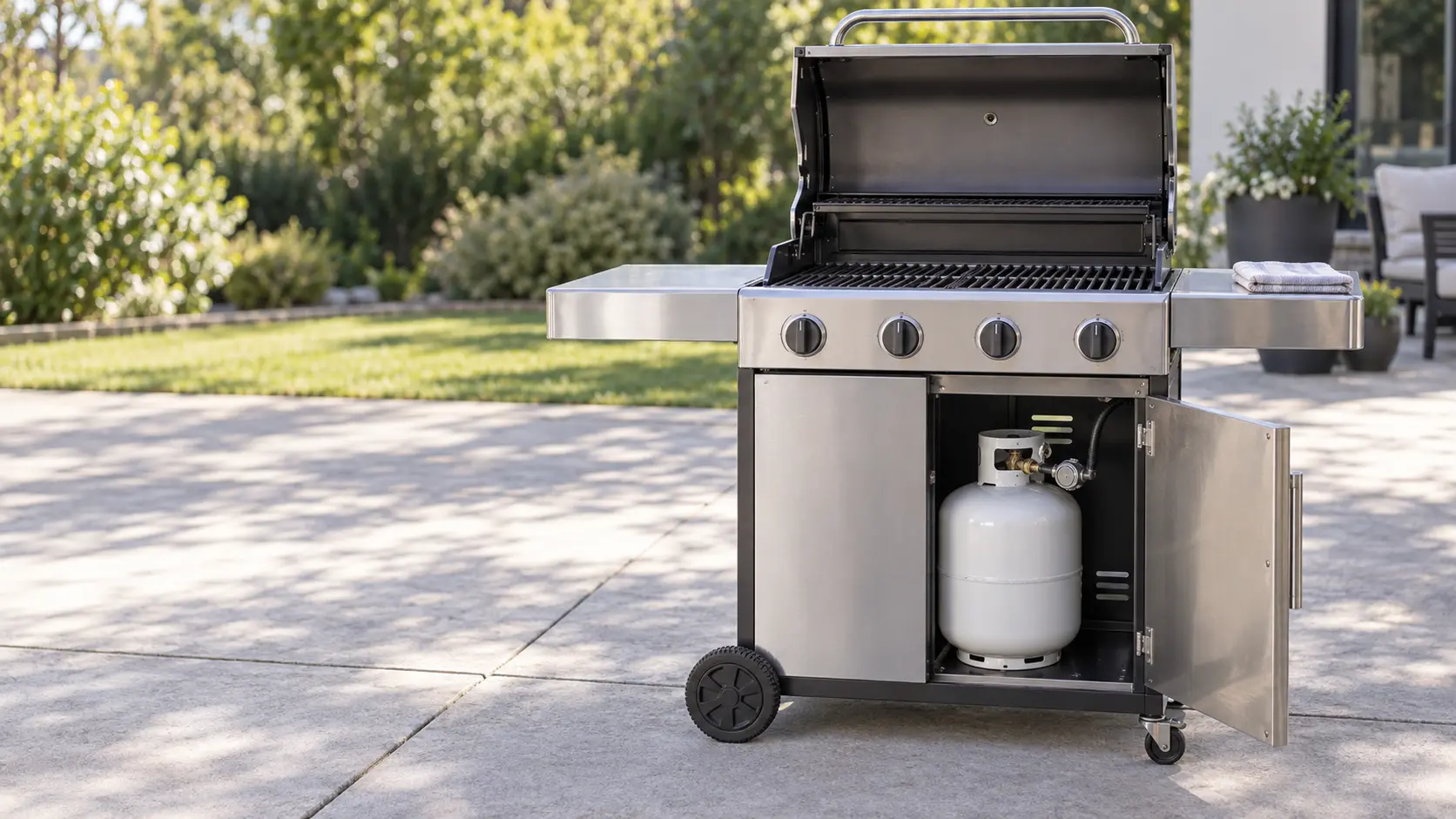
- Regulator hanging free and not touching the grill body.
- Every burner weak, or only one: the answer changes the next step.
Source: Lynx — Care & Use / Installation manual — Improper lighting can activate the cylinder's flow control; reset: burners off, close the valve, wait 30 seconds, reopen very slowly, wait a few seconds; use the supplied hose and regulator; almost-empty cylinders lack pressure; regulator must not touch the grill; Napoleon — Built-In Series owner's manual — Low flow from improper lighting or a valve opened too quickly; regulator low-flow reset: burners off, close the tank, wait 5 minutes, reopen slowly, a few seconds to equalize; humming regulator on hot days is normal; pinched hose