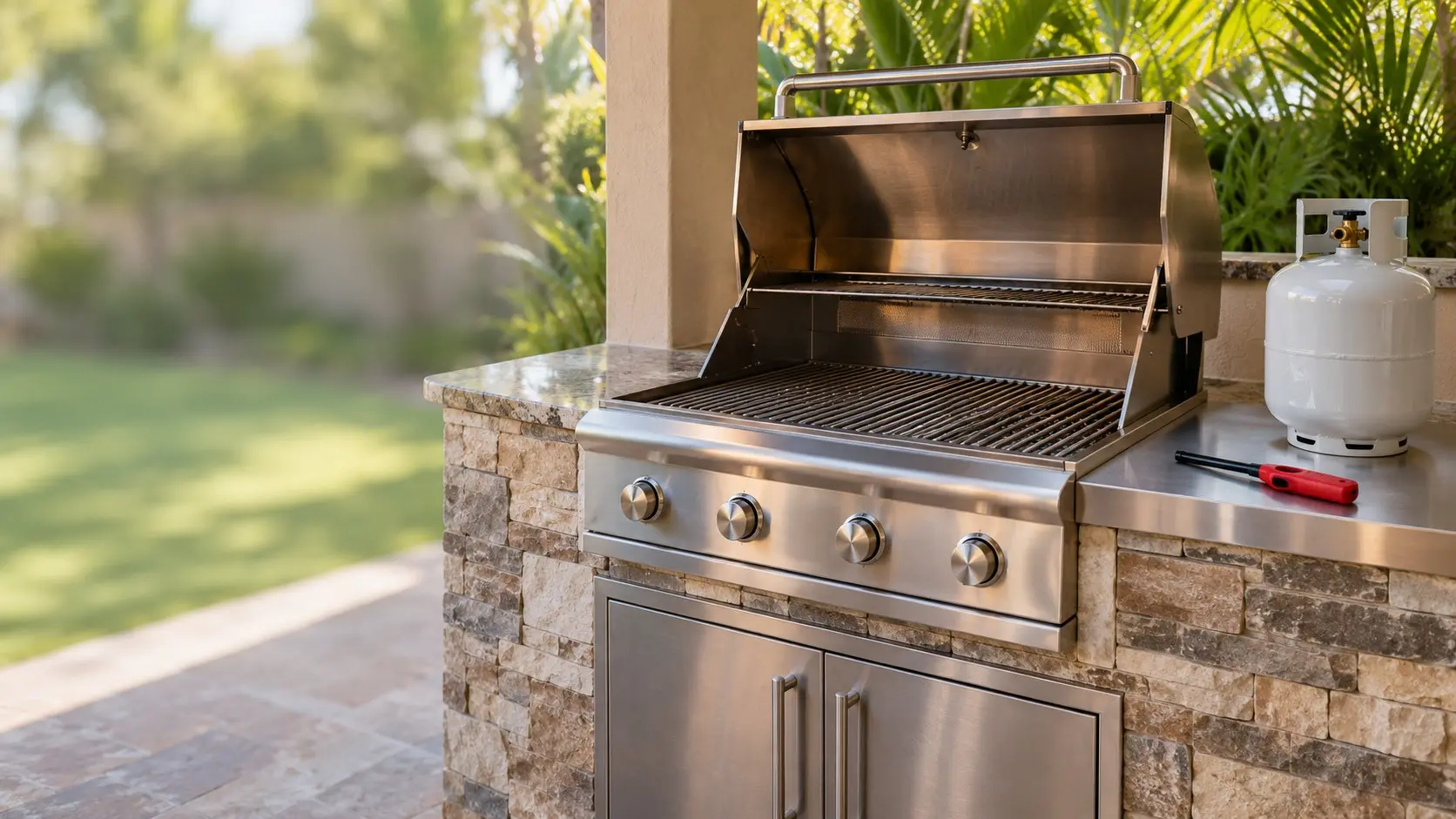


When is it safe to light a gas grill by hand?
It is safe to light a gas grill by hand when the grill has no gas smell, the hose and connections look intact, the lid is open and you can stand at the side with a long-reach lighter or match. The grill is built for it: many cart grill manuals include a match-lighting step for exactly this day.
Skip manual lighting altogether if you smell gas before you start, if the hose is cracked or the grill has been in a fire, or if it is a built-in grill with an enclosed cabinet and you are not sure how the gas is shut off. For why the igniter fails in the first place, see why a grill will not light.
What do you need before you start?
You need a long fireplace match or a long-neck lighter, a clear area around the grill and your manual to hand. Do not use a short book match, which puts your fingers over the burner, and do not use a torch or an accelerant.
- A long-handled match or lighter, at least a few inches longer than your hand
- The lid fully open and propped, with nothing hanging over the grill
- Hair and sleeves out of the way, shoes on, no dangling cords
- A grill cold enough to touch, with no gas smell around it
Where the lighting hole is
On many freestanding gas grills there is a small hole in the side of the firebox or the burner housing, often marked with a flame symbol or described in the manual as the match-lighting hole. A few grills have a removable plate or the main burner is lit from the top. If you cannot find yours, check the manual or look up the rating label; find the grill rating label shows where makers put the model number to search with.

How do you light a grill manually, step by step?
Light the grill with the lid open, as NFPA advises for every gas grill, one burner at a time, and keep your face and body to the side. The order below follows what many owner's manuals describe, so read yours first and follow it where it differs.
- Open the lid fully and turn every burner knob to off.
- Open the cylinder valve slowly, or open the natural gas supply as the manual describes.
- Light the match or lighter and hold it at the lighting hole or beside the burner ports, at arm's length.
- Push in and turn the burner knob nearest the flame to high.
- Watch for the flame to spread along the burner. Turn the knob to the setting you want and light the next burner the same way, or let the crossover carry it.
What if it does not catch?
If the burner does not light within a few seconds, turn the knob off, shut off the gas at the cylinder, leave the lid open and wait at least five minutes before the next try. CPSC's gas grill fact sheet gives 5 to 10 minutes, because propane can build up under the grates; if your manual names a longer wait, use it. Never keep the knob on and keep striking matches, and never reach over the burner to chase the flame.
Natural gas grills and built-ins
A grill on a house gas line is lit the same way, but the supply is a wall or yard shutoff rather than a cylinder. Check the manual for where its match-lighting hole is and how long to wait, and if you are not sure the grill is set for the fuel it is on, do not light it; the rating label names the fuel.
Source: NFPA — Grilling safety — make sure the gas grill lid is open before lighting
What does a good flame look like?
A good flame is mostly blue, steady and runs along the whole burner. Small yellow tips are normal, while a flame that is mostly yellow, lifts off the burner or burns only at one end means the burner, the venturi tube or the gas supply needs attention, covered in why the flame burns low or yellow.
| What you see | What it likely means | What to do |
|---|---|---|
| Steady blue flame along the burner | Normal | Close the lid and preheat |
| Flame only at one end | Blocked ports or a weak supply | Cook on, then book a visit |
| Flame outside the burner housing | Blocked venturi or flashback risk | Turn off, close the gas, call |
| Pop and a flame that vanishes | Lit too slowly or too late | Off, five-minute wait, retry once |
Turning the grill off again
When the cook is over, turn each knob to off, close the cylinder valve or the gas supply, and let the grill cool before covering it. Do the same if the flame goes out mid-cook: knobs off, gas off, lid open, the same waiting time, then start over. Never relight a burner that has blown out by turning the knob up and hoping.
Why is manual lighting only a stopgap?
Manual lighting does nothing about the part that failed, and it puts a lit flame next to the burner every time you cook. A dead battery or a loose electrode wire is a small repair; a corroded module, a wet electrode or a collector box full of grease has a reason it keeps happening, and it will not fix itself.
What the igniter repair covers
A grill igniter repair covers the battery box, the module, the wire to each electrode and the electrode gap, all of which sit near the burners where an owner should not be probing. If the igniter clicks but the grill still will not light, a diagnostic visit separates a spark problem from a gas problem; the fuel and regulator are the next suspects, and resetting the propane regulator is the one gas-side step owners can do themselves.


